Crown repair & rebuild
Chimney crown repair across the South Shore
The crown is the concrete slab across the top of your chimney, and in this climate it is almost always the first thing to fail. When it goes, every problem below it starts.
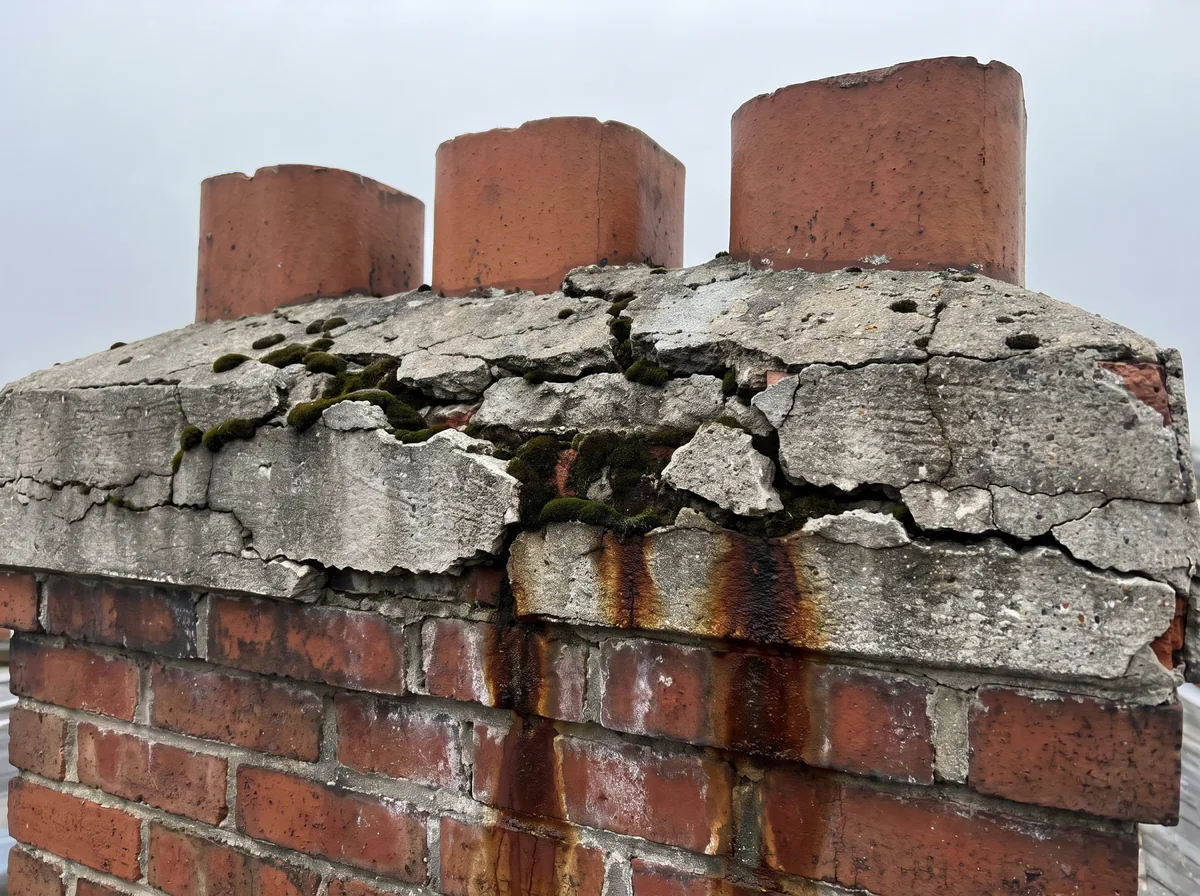
Almost every chimney we are called out to on the South Shore has a crown problem, and most homeowners have never heard the word. So it is worth being precise about what it is, because understanding the crown explains most of what goes wrong with a chimney in this part of Massachusetts.
The crown — sometimes called the crown wash or the crown cap — is the slab of concrete or mortar that covers the top of the chimney's masonry shell. It is not the metal cap over the flue opening; that is a different part. The crown is the sloped surface that the flue liner pokes up through. Its entire job is to take the rain that lands on the top of your chimney and throw it clear of the brickwork below.
A crown built correctly does that with three features. It slopes outward from the flue collar at roughly two inches of fall for every twelve inches of run, so water runs off rather than pooling. It overhangs the face of the chimney by at least two inches, so the water drips clear of the brick instead of running down it. And it meets the flue liner with a small flexible gap, usually caulked with silicone, because the clay liner and the concrete crown expand at different rates and a rigid joint between them will crack every time.
Why crowns fail here faster than almost anywhere else
Two things destroy crowns on the South Shore, and the first is simply how often it freezes.
Water finds a hairline crack in the crown. The temperature drops below freezing, and that trapped water expands by roughly nine percent. Nine percent does not sound like much until you consider that it has nowhere to go, so it widens the crack it is sitting in. Then it thaws, more water gets in than before, and the cycle repeats. Eastern Massachusetts crosses the freezing point somewhere between 80 and 110 times in a typical year — more than Chicago, considerably more than Denver, and among the highest freeze–thaw exposure in the continental United States. Add roughly 44 inches of annual precipitation, more along the coast, and a hairline crack becomes a structural problem in three to five winters.
The second cause is how the crown was built in the first place. A great many crowns on older South Shore homes are not concrete at all but a thin skim of the same mortar the mason used to lay the brick, troweled across the top as an afterthought. Mortar is not designed to be a horizontal weather surface. It has no reinforcement, it is often mixed too wet on site — which weakens it considerably as it cures — and plain Portland cement shrinks as it sets, so it frequently arrives with its first cracks already in place. Those crowns tend to fail within a decade and then keep failing.
What it looks like when a crown is going
You will rarely see the crown itself, because it is thirty feet up and facing the sky. What you see instead is the consequences.
- A brown stain on the ceiling near the chimney breast. Water coming through the crown soaks into the masonry and works downward inside the chase. The stain often appears hours after the rain has stopped, which is the clue that distinguishes it from a flashing leak.
- White chalky deposits on the brick. This is efflorescence — salts carried out of the masonry by water moving through it. It is not cosmetic. It is direct evidence that water is passing through the chimney.
- Grit or chunks of concrete in the firebox, or lying on the roof. The crown is shedding material. If it is landing in the firebox, it is falling down the flue, which usually means the crown has cracked right through at the liner collar.
- A visibly flaking or dished top. Worth looking with binoculars from the ground, which is safer than a ladder and usually enough to tell whether the surface has broken up.
- Spalling brick in the top few courses. Once the crown stops shedding water, the brick immediately below it takes the saturation, freezes, and starts losing its face.
What happens if it is left
A failed crown is not a problem that stays the same size. It is the entry point for everything else.
Water that gets past the crown goes into the masonry, and from there it attacks the mortar joints from behind, saturates the brick so that the next hard freeze can spall the faces off it, and runs down onto the clay flue tiles, where it collects in the joints and cracks them. Cracked flue tiles are a genuine safety matter rather than a maintenance one, because a cracked liner can let combustion gases — including carbon monoxide — reach the inside of the chimney structure and, from there, the house.
Below that, the water keeps going. It rusts the damper solid, it corrodes the firebox, and it shows up on your ceiling. In practical terms, a crown that has been failing unaddressed for three to five years on the South Shore very often escalates from a repair measured in hundreds of dollars into a rebuild measured in thousands.
How the repair is actually done
- We get up there and establish what we are dealing with. There are three quite different repairs here and they are not interchangeable, so the first job is working out which one your chimney needs. We tap across the crown listening for the hollow sound that means the surface has delaminated from what is underneath, probe the cracks to find out how deep they run, check whether the crown still overhangs the brick, and look closely at the joint where the crown meets the flue liner. We photograph all of it.
- We check the flue while we are up there. Crown failure and liner damage travel together often enough that it is worth running a camera down the flue in the same visit when the crown has been open for a while. Finding a cracked tile after you have paid for a new crown is a bad afternoon for everyone.
- Sealing, for a crown that is sound but cracked. If the structure is intact and the cracks are hairline, the right repair is a brush-applied elastomeric crown sealer. It stays flexible, so it can move with the seasonal expansion that caused the cracking in the first place, and it bridges the existing cracks rather than simply filling them. This is genuinely the correct answer on a lot of chimneys and it is the cheapest thing we do.
- Resurfacing, for a crown that is eroded but structurally present. Where the crown has lost its surface but the slab is still doing its job, we clean it back to sound material and bond a purpose-made crown repair compound over the top, rebuilding the slope as we go so it sheds water properly again.
- Full rebuild, for a crown that is past saving. When the crown is cracked through, delaminated, or was never built correctly, we break it out entirely and cast a new one. That means a polymer-modified mix rather than plain mortar, a proper overhang beyond the face of the brick, a correctly pitched slope, a bond break at the flue collar so the liner can move independently, and a flexible sealant at that joint. Built this way it is a different component from the thing we removed.
- We seal the joint and leave it to cure. The silicone joint at the liner is the detail most often skipped, and skipping it is why so many crowns crack in the same place twice. Full cure before precipitation matters, so we watch the forecast rather than the calendar.
What this costs on the South Shore
These are realistic Eastern Massachusetts ranges, published so you can sanity-check any quote you are given — including ours. What moves the number is almost always access rather than materials: chimney height, roof pitch, whether a ladder will do or the job needs scaffolding, and how many flues the crown has to be built around. A single-flue crown on a low ranch in Abington and a four-flue crown on a steep Victorian in Milton are not the same job. Sealing takes an hour or two; a full rebuild is half a day to a full day.
Crowns on older South Shore chimneys
Two local patterns are worth knowing about before anyone quotes you.
Multi-flue chimneys on two-families and three-deckers. Much of Quincy, and North Plymouth, was built out between roughly 1895 and 1940 with two-family and triple-decker housing, and those chimneys frequently carry several flues in one stack — historically one per unit, plus the heating appliance. The crown has to be formed around every one of those liners with a correct bond break at each. It is more work than a single-flue crown and a quote that does not reflect that is a quote from someone who has not looked properly.
Granite coping on historic chimneys. Quincy was the granite capital of nineteenth-century America, and granite shows up all over the local building stock — foundations, steps, and on some older chimneys a cut granite coping stone at the top instead of a cast crown. These should not be ripped off and replaced with concrete as a matter of course. Where the stone is sound, the right work is resetting and repointing it.
When a crown repair is not the answer
We would rather tell you this before you pay us than after. A new crown will not fix a leak that is coming in at the flashing, and it will not fix open mortar joints further down the stack. If the brickwork below has already lost its faces across several courses, a pristine new crown sitting on deteriorated masonry is money spent in the wrong order — that chimney needs repointing or a partial rebuild first, with the crown as part of that work.
Equally, if your crown is sound and your problem is that the masonry is soaking up wind-driven rain, what you may actually want is waterproofing, which is a cheaper and different job. The diagnosis is the valuable part. The repair is just labour.
What people ask about this job
How long should a chimney crown last?
A properly cast crown — correct mix, reinforcement, real overhang, bond break at the liner — should last decades in this climate. A thin mortar wash troweled on at build time often starts cracking within ten years, and once it is cracked the freeze–thaw cycle accelerates the damage every winter. Which one you have matters far more than the age of the house.
Can I seal the crown myself?
The material is available and the application is not difficult. The two problems are that it involves working at the top of a chimney on a pitched roof, which is where roofing falls happen, and that sealing the wrong crown wastes the effort entirely. Sealer bridges hairline cracks on a crown that is structurally sound. Brushed over a crown that has delaminated or cracked through, it hides the problem for a season and changes nothing.
Is the crown the same thing as the chimney cap?
No, and the words get used interchangeably often enough to cause real confusion in quotes. The crown is the concrete slab across the whole top of the masonry. The cap is the metal cover sitting over the flue opening itself, usually stainless with a mesh screen. You can need one, the other, or both. If a quote says 'cap' and you are expecting a new crown, ask which one they mean before signing.
Can crown work be done in winter?
Sealing, sometimes — there are products rated for lower temperatures, and a dry mild spell is workable. A full rebuild really wants temperatures consistently above about 40°F for a proper cure, so from roughly late November through March we are usually recommending a temporary seal to get you through the season and a proper rebuild in spring. If the crown has failed badly in December, a holding repair now is not us upselling you; it is stopping four more months of water entry.
Will insurance cover it?
Usually not. Homeowners policies generally cover sudden and accidental damage — a lightning strike, a tree coming down, storm damage — and generally exclude gradual deterioration and wear, which is what crown erosion is. Where a claim can succeed is when a storm causes identifiable damage, so if your crown was cracked by something that happened on a specific date, photographs and a dated inspection report are worth having. We will document what we find either way; whether it is covered is between you and your insurer, and it depends on your policy.
Do I need a permit?
For crown repair or replacement on its own, typically not. Liner work is different — that does require a building permit in Massachusetts and inspection by the local authority before the installation is closed up. If the crown work turns out to involve relining, that permit requirement applies and we will tell you so up front.
Often needed alongside this
Repointing & Tuckpointing
Mortar is meant to fail before the brick does. When the joints go sandy, water goes straight into the chimney core.
Read more →Chimney Waterproofing
A vapour-permeable repellent that stops wind-driven rain soaking into the masonry, without trapping moisture inside it.
Read more →Chimney Rebuilding
When the brick faces have popped off and the stack is past patching, we rebuild from the roofline or from the footing.
Read more →Get your crown looked at before winter
Tell us what you are seeing and we will tell you what it is likely to be, what it will take to fix, and roughly what it should cost — before anyone climbs on your roof.
Prefer to talk it through? The phone is answered around the clock, by a person, including during storms.
We work across Quincy, Braintree, Weymouth, Hingham, Milton, Hull, Cohasset, Scituate, Norwell, Marshfield and the rest of the South Shore.