Liner installation & relining
Chimney liner installation and relining
If your house went from oil heat to gas and nobody relined the chimney, the flue has been condensing acid onto its own tile ever since. It is the most common chimney problem on the South Shore and almost nobody knows they have it.
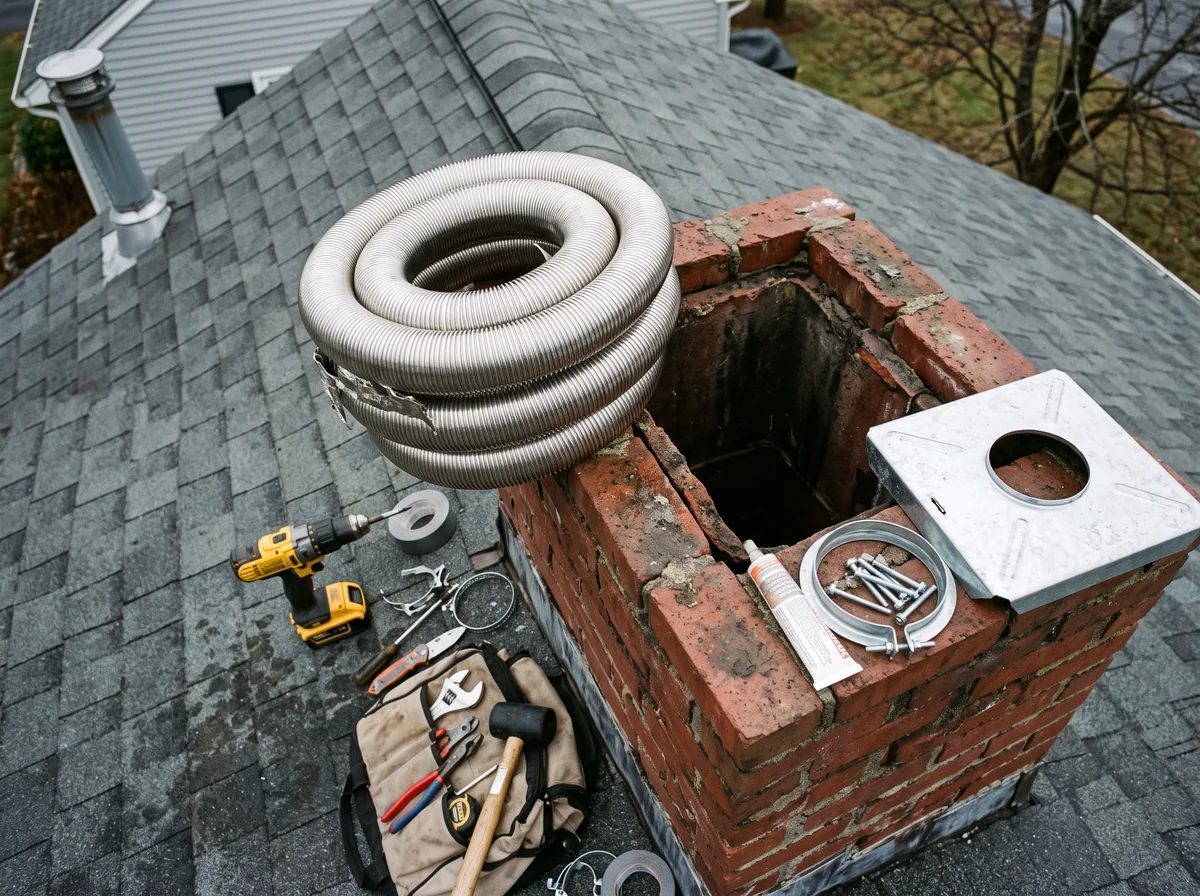
Start with the conversion problem, because it is the reason most people on the South Shore end up on this page.
Natural gas distribution expanded through Quincy, Braintree, Weymouth and Hingham and eventually into parts of Plymouth from roughly 2005 onwards, and a large share of the region's housing stock switched from oil heat to gas over the following fifteen years. A great many of those conversions replaced the appliance and left the chimney exactly as it was. That is the problem, and it is a physics problem rather than a paperwork one.
Take the typical case: a two-family or three-decker in Quincy with a seventy-year-old clay tile flue that was sized for a 200,000 BTU oil boiler, now venting a 100,000 BTU gas boiler. Oil burns hot and comparatively dry; its exhaust goes up the flue fast and stays well above the temperature at which anything in it condenses. Gas burns cooler and produces a great deal more water vapour — water is one of the principal products of burning methane. And there is now roughly half the heat input going up a flue with about twice the cross-sectional area the appliance needs.
So the exhaust moves slowly, loses heat to a large cold masonry mass on the way up, and falls below its dew point somewhere inside the chimney. The water vapour condenses on the tile. That condensate is not clean water — it carries combustion products in solution and is acidic. It sits in the tile joints and on the tile faces and it dissolves mortar and attacks clay. A liner that was perfectly serviceable under oil can deteriorate significantly within two to five years of a gas conversion.
Nothing about this is visible from inside the house. There is no smell, no noise, no change in how the heat works. The homeowner who bought a South Shore house in 2015 with a recently converted gas boiler may be ten or fifteen years into a flue that has been quietly coming apart from the inside the whole time. The condition is only found by putting a camera down it.
It also matters that Massachusetts code does not treat this as optional. Under 780 CMR, the liner must be adequate for the appliance it serves, and an existing chimney serving a changed appliance must be resized. A conversion that left the original oil-era flue in place did not comply at the time and does not comply now.
What a liner is and why the code requires one
A liner is a continuous, smoke-tight passage running the full height of the chimney, from the appliance connection to the top. It does three separate jobs and it is worth separating them, because different failures compromise different ones.
It contains the combustion gases. Everything the appliance produces, including carbon monoxide, is supposed to stay inside the liner until it leaves the top of the chimney. A cracked or open liner lets those gases into the masonry, and masonry is not airtight — from the chimney structure they can reach wall cavities and from there the living space. This is the safety argument and it is the reason liner defects are not deferrable maintenance.
It protects the masonry. Heat and acidic condensate both attack brick and mortar. The liner takes that load so the structure does not.
It sizes the flue for correct draft. Draft is a function of flue cross-section, flue height and gas temperature. A flue that is too large for its appliance drafts slowly, cools its exhaust, and condenses. A flue that is too small cannot clear the products of combustion fast enough. Sizing is not a detail — it is most of the engineering in the job.
NFPA 211 and the Massachusetts residential code both require liners to be adequate for the appliance served, continuous, and built of listed or approved materials. In Massachusetts that means 780 CMR 51.00, the Tenth Edition Residential Code, which adopts the 2021 IRC with state amendments. The accepted systems are a listed flexible metallic liner to UL 1777, clay tile to ASTM C315, or an approved equivalent. The same code requires resizing when the appliance changes.
Clay tile and stainless steel
Clay tile. Terracotta tile set in mortar as the chimney was built is the traditional liner and is what you will find in most masonry chimneys built between roughly 1910 and 1980. It is cheap, it drafts well, and installed properly it lasts a very long time. Its weaknesses are all about joints and brittleness. The mortar joints between tiles erode over decades. Tiles crack from freeze–thaw where water has got into the flue from a failed crown, and they crack from thermal shock in a chimney fire, which can reach well over 2,000°F and shatter tile outright. And they are attacked quickly by acidic condensate from gas appliances, which is the conversion problem above.
The practical consequence is that clay tile cannot be replaced in kind without taking the chimney apart. A damaged tile liner is not repaired tile by tile; the chimney is relined with a different system inside the existing flue.
Stainless steel flexible liner. This is the dominant relining method and for most South Shore chimneys it is the right answer. A flexible stainless tube, listed to UL 1777 as part of a complete system, is lowered into the existing flue from the top, connected to the appliance at the bottom and terminated with a top plate and rain cap.
Alloy selection is driven by fuel. 316L stainless is the standard for natural gas and for wood. 904L — a considerably more corrosion-resistant and more expensive alloy — is specified for oil and for coal, because those fuels produce more aggressive residues, and this is a real distinction rather than an upsell. Putting a gas-grade liner on an oil appliance is a specification error.
A liner is a system, not a tube. The listing covers the liner, the top plate, the rain cap, the tee connection at the base, the cleanout and the appliance connector, and components have to come from the listed system for the listing to mean anything. Mixed components are a common shortcut and they invalidate the thing the code is asking for.
How the diameter is actually determined
This is the most commonly mishandled part of relining, and it is worth being blunt: the correct liner diameter is not the diameter of the tile you are replacing.
Size is calculated from the appliance's BTU input, the vent height, the fuel type and the venting configuration, using the tables in NFPA 211 or the appliance manufacturer's instructions. Massachusetts code says the same thing explicitly — liner sizing must match appliance input, vent height and fuel, and must not automatically match the existing tile dimensions.
The reason matters. Vent height affects draft directly, because the stack effect that pulls exhaust up the chimney is a function of the column height and the temperature difference across it. A tall chimney on a three-decker develops far more draft than a short one on a single-story ranch in Abington, so the same appliance can require different flue areas in the two houses. Input matters because the volume of gas being moved scales with it. And an oversized flue does not merely waste space — it actively causes the condensation and the acid attack, because the exhaust slows down and cools below its dew point before it gets out.
So when a liner is correctly sized down for a gas appliance, three things happen at once. The effective cross-section drops, gas velocity rises, and flue temperature stays above the dew point for the full height. The condensation stops. That is the whole objective, and it is why the answer to an oversized oil-era flue is a smaller liner rather than a new tile of the same size.
Insulation, and when a poured liner is the better answer
Insulation wrap. A stainless liner running up the middle of a large cold masonry chimney loses heat to that masonry. An insulating blanket or vermiculite-based insulation around the liner keeps flue temperatures up, which improves draft, reduces condensation further and reduces creosote deposition on solid fuel appliances. On an exterior chimney — one built on the outside wall of the house rather than running up through the middle of it — it makes a substantial difference, because the whole flue is sitting in outdoor temperatures. Some liner listings require insulation for the listing to apply, in which case it is not optional. It typically adds $300 to $800.
Poured-in-place and cast refractory systems. Where the clay tile is cracked but still in position, an alternative to inserting a metal liner is to cast a new one inside the old. An insulating refractory mixture is pumped around a form positioned inside the existing flue, and when the form is withdrawn what remains is a continuous, smooth, code-compliant liner bonded to the inside of the chimney. HeatShield, SL-100 and Golden Flue are the systems you will see named.
It costs more than stainless. Its advantages are that it does not require a metal tube to be threaded down an offset or obstructed flue, it can restore a flue whose tile has failed without disturbing the chimney structure at all, and it leaves no metal in the chimney — which is the reason it is often the right specification on historically sensitive properties, including the antique housing stock in downtown Plymouth, Hingham Centre and Cohasset, where the presence of a stainless liner is objectionable or where the flue geometry is too irregular for a tube.
Permits and inspection in Massachusetts
Liner work requires a building permit in Massachusetts. This is not a formality that experienced contractors skip.
The installation must be inspected by the authority having jurisdiction — the local building inspector, and in some communities the fire department — and that inspection needs to happen before the cleanout and the top connection are sealed, because once the system is closed up nobody can see what was installed. Work involving gas appliance venting may additionally require a gas plumbing permit under 248 CMR. Requirements vary between building departments, so the specifics are confirmed with your town rather than assumed.
Separately, any contractor performing home improvement work in Massachusetts is required to hold Home Improvement Contractor registration, which you can verify at mass.gov. It is a baseline legal requirement rather than a competency credential, but a contractor without it has no statutory right to recover payment from you, which tells you something about who you are dealing with.
How a relining job is actually done
- We scan the flue before quoting anything. A camera goes down the full height of the chimney. That is what a Level 2 inspection includes, and it is the only way to see cracked tiles, eroded tile joints, displaced tiles, blockages, debris and the white or crumbling surfaces that indicate condensate attack. NFPA 211 calls for a Level 2 inspection specifically when the appliance or fuel type has changed, which is exactly the oil-to-gas situation, as well as on change of ownership and after a chimney fire.
- We take the appliance data and the chimney dimensions. The BTU input off the appliance data plate, the fuel, the vent configuration and the measured vent height. Those numbers go into the sizing tables in NFPA 211 or the manufacturer's instructions and produce a required flue area. We also measure the existing flue, because the liner has to physically fit down it — occasionally the calculated size will not pass an offset or a tight tile, and that changes the specification.
- We specify the system, not just the tube. Alloy by fuel — 316L for gas and wood, 904L for oil and coal. Insulation where the listing requires it or where an exterior or oversized chimney makes it worthwhile. Top plate, rain cap, tee and cleanout, appliance connector, all from the same listed system so the UL 1777 listing actually applies to what is installed.
- We pull the permit. The building permit is taken out with your town before work starts, and the inspection is scheduled so it can happen while the system is still open. Where gas venting is involved we establish whether a gas permit under 248 CMR is also needed.
- We clear and prepare the flue. Debris, fallen tile, old nests and creosote come out first. A liner should not be lowered past an obstruction or over accumulated rubble in the base of the flue. Where tiles have dropped or a bulge is restricting the flue, that is dealt with before the liner goes in rather than fought with on the way down.
- We install from the top down and connect at the base. The liner is lowered from the chimney top, insulated where specified, and connected to the appliance with the listed connector and tee. The top plate seals the flue opening and supports the liner, and the rain cap goes on above it. The cleanout at the base stays accessible — it is the access point for every future sweep and inspection.
- We get it inspected before anything is sealed. The inspector sees the installation while the connections are still open. That is the point of the requirement. Once the sign-off is done the system is closed up and the appliance is fired and checked for correct draft.
- We deal with the crown and cap in the same visit. A new liner passing through a cracked crown is a new liner that will have water running down the outside of it. The crown-to-liner joint needs a bond break and flexible sealant so that the crown and the liner can move independently. If the crown is failing it is repaired or recast as part of the work.
What this costs on the South Shore
These are realistic Eastern Massachusetts ranges. What moves the number is chimney height, the alloy the fuel requires, whether the flue is straight or has offsets that complicate the run, whether insulation is specified or required by the listing, how much clearing the flue needs before the liner can go down, and access at the chimney top. Oil and solid-fuel systems cost more than gas because 904L and heavier-gauge material cost more, not because the labour differs much. Permit fees are set by your town. A straightforward single-flue reline is usually a one-day job.
If you converted to gas, what to do about it now
The useful action is a camera scan, not a guess. A Level 2 inspection with a video scan of the full flue interior runs roughly $250 to $500 in Eastern Massachusetts and it answers the question definitively: whether the tile is intact, whether the joints have been eroded by condensate, and what the flue actually measures against what your appliance needs.
Three situations make this worth doing now rather than at some point. If your house converted from oil to gas at any time and you have no documentation of liner work, assume the flue was never resized until a scan proves otherwise. If you are buying a South Shore house with a gas boiler and an older masonry chimney, a Level 2 scan before closing is the cheapest form of leverage available — relining is a routinely negotiated repair, and it is much better to know the number before the price is agreed. And if you are replacing the boiler or furnace anyway, do the liner at the same time, because the appliance is disconnected and the flue is accessible.
The neighbourhoods where this comes up most are the ones where oil heat was historically dominant and gas mains arrived later: Germantown, West Quincy and the Quincy triple-decker districts, North Plymouth, the older parts of Weymouth and Braintree. If your street was converting in the late 2000s and 2010s, your chimney very probably has the same story as your neighbours'.
Oil flues in the towns gas never reached
Not everywhere on the South Shore converted. Natural gas distribution does not serve much of South Plymouth and Cedarville, and oil heat remains strongly dominant in Duxbury, Marshfield, Norwell, Kingston and across the interior towns — Pembroke, Hanover, Rockland, Abington, Whitman, East Bridgewater.
Those chimneys have the opposite profile. Oil vents hot and comparatively dry, so clay tile in an oil flue tends to hold up considerably better than tile that has been asked to handle gas exhaust. The issue there is simply age. A clay liner installed with the house in the 1950s or 1960s is now 60 to 70 years old, its mortar joints have been eroding that whole time, and freeze–thaw damage from water entering through a failed crown does not care what fuel is burning below. Tile liners past 40 to 50 years of service are worth scanning on their own account.
The other trigger in these towns is appliance replacement. When a fifty-year-old oil boiler is replaced with a modern high-efficiency oil unit, the new appliance has a different input and different venting requirements, and the code requirement to resize on appliance change applies to oil exactly as it does to gas. Where a liner is required for an oil appliance, the alloy specification is 904L rather than the 316L used for gas, and that difference is reflected in the price.
What people ask about this job
I converted from oil to gas. Do I really need a new liner?
Almost certainly, if the gas appliance vents into the original masonry chimney. Gas exhaust is cooler and much wetter than oil exhaust, and the oil-era flue is typically around twice the cross-section the gas appliance needs. The exhaust therefore moves slowly, cools below its dew point inside the chimney, and condenses. That condensate is acidic and attacks clay tile and its mortar joints rapidly — a liner that was fine under oil can deteriorate noticeably within two to five years of conversion. Massachusetts code requires the liner to be resized when the appliance changes. A stainless liner sized for the gas appliance is the standard fix.
Why can't the new liner just be the same size as the old clay tile?
Because the tile was sized for a different appliance. Liner diameter is calculated from the appliance's BTU input, the vent height and the fuel, using the tables in NFPA 211 or the manufacturer's instructions, and Massachusetts code specifically says sizing must not automatically follow the existing tile dimensions. An oversized flue is not harmlessly generous — it slows the exhaust, lets it cool below its dew point, and causes the condensation and acid attack that the relining is meant to stop. Sizing down is usually the entire point of the job.
What is the difference between 316L and 904L stainless?
Corrosion resistance and price. 316L is the standard alloy for natural gas and for wood-burning appliances and is what the great majority of South Shore relining jobs use. 904L is a higher-nickel, higher-molybdenum alloy specified for oil and for coal, because the residues those fuels produce are considerably more aggressive. It costs more, which is most of the difference between the gas and oil price ranges. Either way the liner should be part of a complete system listed to UL 1777, with the top plate, cap, tee and connector from that same system.
Do I need a permit to have a chimney liner installed in Massachusetts?
Yes. A building permit is required for liner installation under 780 CMR, and the installation must be inspected by the local authority having jurisdiction — usually the building inspector, sometimes with the fire department — before the cleanout and top connection are sealed. Work involving gas appliance venting may also require a gas plumbing permit under 248 CMR. Requirements vary slightly by town, so they are confirmed with your building department. A quote that does not mention a permit is a quote worth questioning.
How long does a stainless liner last?
A correctly specified liner — right alloy for the fuel, correctly sized so it is not condensing, part of a listed system, insulated where the listing or the chimney calls for it — is a long-service component, and manufacturers back the better systems with substantial warranties. What shortens a liner's life is being asked to do a job it was not specified for: gas-grade alloy on an oil appliance, an oversized liner condensing acid onto itself, or an uninsulated liner in a cold exterior chimney running permanently below its dew point. The specification is what determines the lifespan, not the brand.
What is a poured-in-place liner and when is it worth the extra cost?
An insulating refractory mixture is pumped around a form set inside the existing flue, creating a new smooth continuous liner cast in place against the old tile. It runs roughly $3,000 to $8,000 depending on chimney height, against $1,500 to $4,000 for a typical stainless installation. It earns the difference in three situations: where the flue has offsets or irregular geometry that a rigid or flexible tube cannot negotiate, where the existing tile is cracked but still in position and you would rather not disturb the chimney structure, and on historically sensitive properties — a good deal of Plymouth, Hingham Centre and Cohasset — where a metal liner is unwanted or inappropriate.
Often needed alongside this
Chimney Inspection
Level 1, 2 and 3 inspections, including the camera scan buyers and insurers ask for.
Read more →Chimney Rebuilding
When the brick faces have popped off and the stack is past patching, we rebuild from the roofline or from the footing.
Read more →Chimney Sweeping
Creosote removal and a clean flue — plus an honest answer about what stage of buildup you actually have.
Read more →Find out what your flue is actually sized for
Tell us what you are seeing and we will tell you what it is likely to be, what it will take to fix, and roughly what it should cost — before anyone climbs on your roof.
Prefer to talk it through? The phone is answered around the clock, by a person, including during storms.
We work across Quincy, Braintree, Weymouth, Hingham, Milton, Hull, Cohasset, Scituate, Norwell, Marshfield and the rest of the South Shore.