Waterproofing & sealing
Chimney waterproofing across the South Shore
Waterproofing a chimney means treating the brick with a penetrating repellent that lets the masonry breathe. It is not paint, and using the wrong product here does more damage than doing nothing at all.
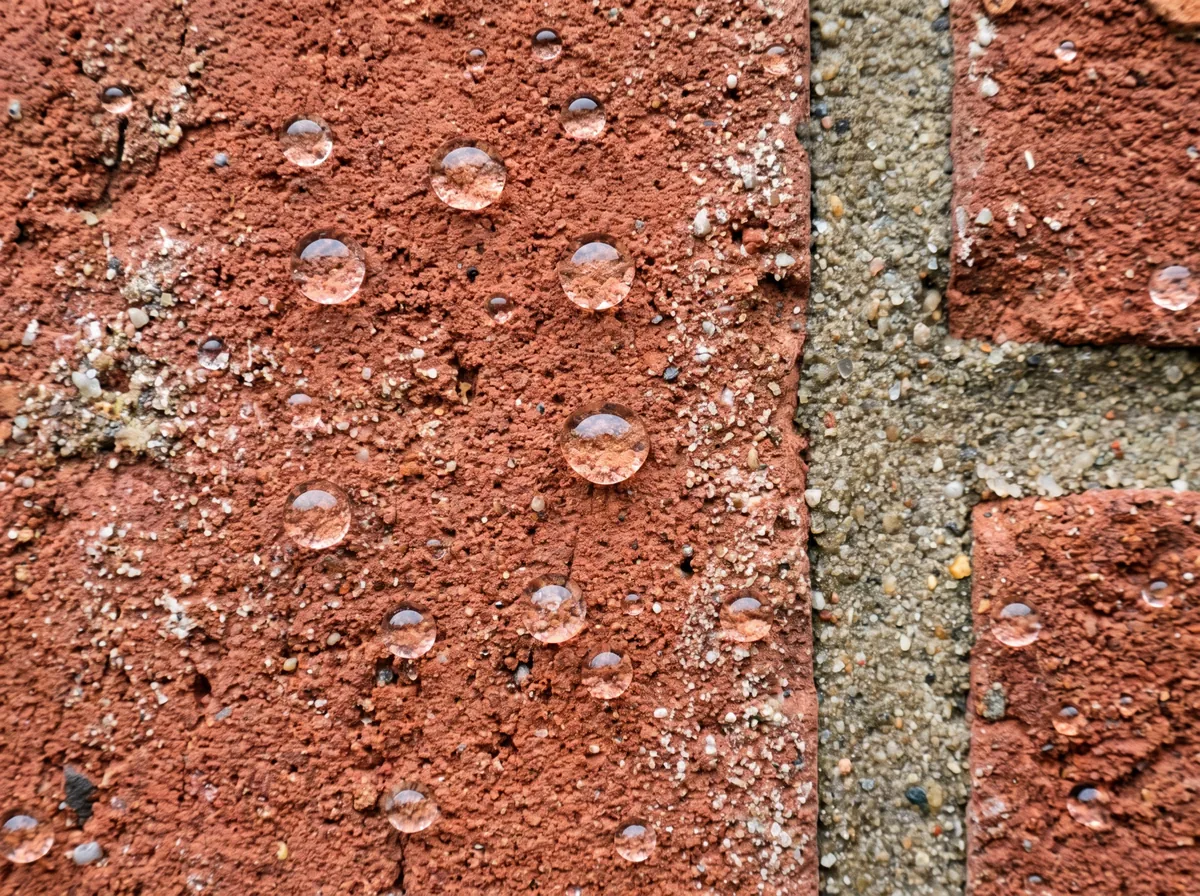
Brick is not waterproof. It never was. A fired clay brick is a porous solid, and the pores are connected, which means a brick chimney absorbs water like a sponge with a slow drain. On a wall with a roof over it that is tolerable. A chimney is exposed on all four sides at the highest point on the building, where wind-driven rain is most severe, so it takes more water than any other masonry on the house and has the least help drying out.
In a climate that crosses the freezing point roughly 80 to 110 times a year — among the highest freeze–thaw exposure in the continental United States — saturated masonry is the mechanism behind most of what goes wrong with chimneys here. Water in the pores freezes, expands by about nine percent, and has nowhere to go, so it fractures the material around it. Repeated enough times the brick face pops off. That is spalling, and a spalled brick has lost its face and absorbs water faster than before.
Waterproofing addresses that absorption directly. It does not address anything else, and being clear about the boundary is most of the value of this page.
Penetrating repellent, not a coating — and why the difference is the whole point
There are two entirely different things sold as chimney waterproofing, and one of them causes expensive damage.
A penetrating water repellent — products in the class of ChimneySaver Water Repellent, Hy-Dry and comparable formulations — is a thin, usually near-invisible liquid that soaks into the brick and mortar and chemically bonds inside the pore structure. It does not fill the pores. It lines them, changing the surface energy of the pore walls so they repel liquid water. Rain landing on treated brick beads and runs off instead of wicking in. The critical property is that the pores stay open to vapour. Water vapour inside the masonry — from flue gas, from residual moisture, from the inside of the house — can still move outward and evaporate. This is what vapour-permeable means, and it is the reason the right product works.
A non-permeable coating — masonry paint, elastomeric wall coating, sealers that form a continuous film, and the various DIY products that look like they should be fine — does the opposite. It forms a skin on the outside of the brick. For a while it looks excellent and the brick looks dry. Meanwhile water is still getting into the chimney from above, from the joints, from the inside, and now it cannot get out, because the one surface it used to evaporate from has been sealed. Moisture accumulates in the masonry behind the film. When it freezes, it expands against a surface that cannot relieve the pressure, and the failure mode is not a hairline crack but the face of the brick coming off in sheets along with the paint that is bonded to it. Freeze–thaw damage becomes dramatically worse than it would have been on untreated brick.
This is a genuinely common and genuinely expensive homeowner mistake. A painted chimney cannot easily be un-painted; stripping masonry coatings is slow, damaging to the brick face, and often not worth doing, which means a painted chimney that has started spalling is frequently on a path to partial rebuild. If someone offers to waterproof your chimney and the product they describe forms a film, changes the colour, or is described as a coating or a paint, that is not chimney waterproofing and you should not let them do it.
What waterproofing does not fix
We would rather say this before you pay us than after. Waterproofing treats a porous surface. It does nothing whatsoever about a hole.
- Active cracks. A repellent works at pore scale. It has no bridging ability, so a crack wide enough to see is a crack wide enough to keep taking bulk water after treatment.
- A failed crown. If the slab across the top of the chimney is cracked through, delaminated or no longer overhanging the brick, water is going into the top of the masonry regardless of what has been applied to the faces. Crown repair comes first.
- Failed flashing. Water entering at the roof junction is inside the building envelope before it ever touches treated brick. That is flashing work.
- Open or sandy mortar joints. If mortar can be scratched out with a key, or the joints are visibly open, they need repointing. Repellent applied over failed joints seals nothing and wastes the material.
- A missing cap. Rain and snow falling straight down an open flue is not a masonry absorption problem.
The correct sequence is repair first, waterproof second. Waterproofing is what protects a repaired chimney and keeps it repaired; it is not a cheaper alternative to the repair. Where it is genuinely the right standalone job is a chimney that is structurally sound — sound crown, sound flashing, sound joints — and is simply absorbing more water than it can shed. That is a real and common situation, particularly on exposed and coastal properties, and it is worth treating before it becomes a masonry repair.
How to tell whether your chimney is absorbing water
You are looking for evidence of water moving through the masonry rather than water arriving somewhere it shouldn't.
- Efflorescence. White, chalky, powdery deposits on the brick face. These are soluble salts that water has carried out of the masonry and left behind as it evaporated. Efflorescence is not cosmetic and it is not a stain to be scrubbed and forgotten — it is direct proof that water is passing through the brick. It can be cleaned, and it will come back until the water is dealt with.
- Brick that stays visibly dark for a long time after rain. A chimney that dries out in a few hours is shedding water. One that is still dark two days later is holding it.
- Early-stage spalling. Pock-marked faces, small flakes of brick on the roof or in the gutters, red or orange grit in the gutter run. This is the freeze–thaw cycle already working.
- Chronic darkened faces on the north and east elevations. The faces that get the least sun and, on the South Shore, the worst of the driven rain. Higher-elevation and wind-exposed sites — Wollaston Heights is a local example — show this earlier than sheltered ones.
Salt air: Hull, Scituate, Cohasset and the Plymouth waterfront
Coastal chimneys have a second deterioration mechanism running alongside freeze–thaw, and it does not need a frost to do damage.
Salt-laden air off Massachusetts Bay and Boston Harbor deposits sodium chloride and other salts into the pores of the masonry. As those pores cycle between wet and dry, the salt crystallises, and crystallisation inside a confined pore generates pressure. That pressure fractures the brick face from within. The term is subflorescence — salt crystallising below the surface rather than blooming onto it — and it is additive to freeze–thaw damage, not an alternative to it. It works year round, including through a mild winter.
The towns where this matters most are the ones with water on several sides. Hull sits on a narrow peninsula in Boston Harbor and has the fastest masonry deterioration on the South Shore for exactly this reason. Much of Scituate, waterfront Cohasset, the North Plymouth and Plymouth waterfront, and Quincy's Houghs Neck, Squantum and Marina Bay are in the same position. Properties within roughly a quarter of a mile of the shoreline show measurably faster deterioration than inland South Shore towns, and mortar joints in those locations may need attention every 8 to 12 years rather than the 15 to 20 typical inland.
A penetrating repellent helps here in two ways. It reduces the liquid water getting in, and liquid water is what carries the salt into the pores in the first place. And because it stays vapour-permeable, the masonry can still dry outward, which is essential in a salt environment — a film coating on a salt-loaded coastal brick chimney is the worst of both mechanisms at once. Waterproofing does not make a Hull chimney behave like an Abington chimney. It slows the clock, which on a coastal property is worth having.
How the work is actually done
- We inspect before we quote sealer. The first question is whether waterproofing is the right job at all. We look at the crown for cracks, delamination and overhang; the flashing at the roof junction; the mortar joints on all four faces, probed rather than glanced at; the brick faces for spalling; and whether there is a cap and whether it fits. If any of those has failed, sealing the faces is money spent in the wrong order and we will say so.
- We establish what has already been applied. Previously painted or film-coated masonry changes the job completely, and so does an earlier treatment with a repellent that is still partly working. Penetrating products need open pores to get into. Applying one over an existing film achieves nothing, and it is worth knowing that before the material goes on rather than after.
- Repairs first, in the right order. Crown, flashing and joints get repaired before anything is sealed. Fresh mortar also needs time to cure before treatment. Waterproofing after repointing is the classic pairing and it is the point at which the treatment does the most good, because you are protecting new joints from the weathering that destroyed the old ones.
- The surface is cleaned and efflorescence treated. Loose material, organic growth and dust come off, and efflorescence is treated rather than sealed under. Salt deposits left on the surface interfere with the bond and, more to the point, the salt is evidence of a water path that should have been dealt with in the previous step.
- Two coats of penetrating repellent, wet-on-wet. The material goes on by brush, roller or pump sprayer, and the second coat is applied before the first has dried. Wet-on-wet is standard practice for most manufacturers' instructions rather than a shortcut: the second coat carries into the still-open wet surface and reaches deeper into the pore structure than it would over a dried first coat. Coverage rates on masonry are generous by paint standards, and the common failure in DIY application is spreading the material too thin to penetrate properly.
- Full cure before precipitation. The treatment has to cure before it gets rained on, which makes the forecast part of the specification. This is why waterproofing is scheduled around the weather rather than the diary, and why late autumn on the South Shore is an awkward window — there are fewer dry spells long enough to be confident about.
- We document what was used and where. Product, number of coats, date and photographs, so that when the reapplication question comes round in five to ten years there is a record rather than a guess, and so a future contractor knows what is already on the brick.
What this costs on the South Shore
The waterproofing figure is a realistic Eastern Massachusetts range for a standard two-storey residential chimney, published so you can sanity-check any quote you are given — including ours. What moves it is size and access rather than material: chimney height and girth, roof pitch, whether a ladder will do or the job needs staging, and how much surface area there is to cover. The other three rows are here because waterproofing is very often the last step of a larger job rather than a standalone visit, and it is frequently bundled with crown repair or repointing — which is sensible, because the staging and access are already paid for. If you are quoted waterproofing alone on a chimney with open joints or a cracked crown, ask why the repairs are not in the quote.
How often it has to be redone
A penetrating repellent is not permanent. The typical reapplication interval is five to ten years, and where in that range a particular chimney falls depends on exposure more than anything else. A sheltered inland chimney sits at the long end. A south- or east-facing stack on a Hull or Scituate property taking salt spray and driven rain sits at the short end. Exact product-specific performance periods vary, and anyone quoting you a precise number of years for a particular brand is quoting marketing rather than measurement.
The practical test is the same one that told you to treat it in the first place. Watch the brick during and after rain. While the treatment is working, water beads and the faces dry quickly. When rain starts darkening the brick again and the chimney holds that dark colour for a day or more, absorption has returned and it is time to reapply. Efflorescence reappearing on a chimney whose crown, flashing and joints are all sound is the same signal.
Reapplication is cheaper and simpler than the first treatment when the masonry has stayed sound, because there is no repair work in front of it. It is also the cheapest maintenance item on a masonry chimney, which is the argument for doing it on schedule rather than when the spalling starts.
Where waterproofing earns its keep, and where it does not
Worth doing. Immediately after repointing or crown work, to protect what you just paid for. On a structurally sound chimney that shows efflorescence or stays wet for days after rain. On exposed coastal properties, on high-elevation and wind-exposed sites, and on any chimney where the brick is visibly soft or the original firing was light — common on pre-1940 New England brick, which was fired softer than modern brick and is correspondingly more absorbent. Ahead of a winter, if the timing allows a proper cure.
Not worth doing yet. On a chimney with a failed crown, failed flashing, open joints or spalled brick, because those have to be repaired first and the repair will disturb the treated surface anyway. On brick that has already been painted or film-coated, where the pores are not available. And on a chimney where the actual complaint is water in the firebox during cold weather with no rain — that is condensation from an oversized or deteriorated flue, and the answer is a correctly sized liner, not anything applied to the outside.
Pre-1940 masonry deserves one extra note. Those chimneys were built with lime-based mortars and soft-fired brick, a system designed to move and breathe. Anything that reduces its ability to dry outward is more dangerous on that masonry than on modern brick, which is another reason the permeability question is not a technicality. Plymouth in particular has the highest concentration of pre-1800 structures on the South Shore, and a lot of masonry that predates modern materials entirely.
Doing it yourself
The material is available to homeowners and the application is not difficult in principle. Three things go wrong.
The first is product selection, and it is the serious one. A shelf of masonry products in a hardware store includes both vapour-permeable penetrating repellents and film-forming coatings, and the labelling does not always make the distinction obvious. Choosing wrong on a chimney does not merely fail to help; it accelerates the damage you were trying to prevent, and it is close to irreversible.
The second is that it involves working at the top of a chimney on a pitched roof, which is where roofing falls happen. Binoculars from the ground are a genuinely useful diagnostic tool and a ladder at the eaves is not.
The third is that sealing the wrong chimney wastes the whole effort. If the crown is cracked or the joints are open, a perfectly applied treatment changes nothing you will be able to measure. The diagnosis is the valuable part. The application is just labour.
What people ask about this job
What is chimney waterproofing and should I have it done?
It is the application of a penetrating, vapour-permeable water-repellent sealer to the exterior masonry. Unlike paint, a proper chimney waterproofer prevents surface water infiltration while still allowing moisture to transpire out of the masonry. It is most appropriate after repointing or masonry repair, or on a structurally sound chimney showing high moisture absorption. It is not a substitute for fixing crown, flashing or mortar failures. On coastal South Shore properties it provides valuable additional protection against salt-laden wind-driven rain.
Why can't I just paint the chimney?
Because paint forms a film, and a film traps moisture inside the masonry. Water will still reach the chimney from the top, from the joints and from inside, and the face you have sealed is the surface it used to dry through. Trapped moisture that freezes expands against a surface that cannot relieve the pressure, and brick faces come off in sheets with the paint bonded to them. It makes freeze–thaw damage dramatically worse, it looks fine for the first couple of years, and stripping it off afterwards is slow, damaging and often not economic.
Will it change how the brick looks?
A penetrating repellent is essentially invisible on cured masonry. There is usually a temporary darkening while it is wet, and it dries back to close to the original appearance with no gloss and no film. Because it is not a coating there is nothing to peel, flake or go patchy as it ages — it simply stops repelling water eventually. If a product noticeably changes the colour or adds a sheen, that is a sign it is forming a film, which is not what you want on a chimney.
How long does it last and how will I know when to redo it?
Typically five to ten years, with exposure deciding where in that range you land. Exact product-specific performance periods vary. The test is observational: while it is working, rain beads on the brick and the faces dry quickly. When rain starts darkening the brick again and the chimney holds that colour for a day or more, absorption is back. Efflorescence returning on a chimney with a sound crown, sound flashing and sound joints is the same signal.
Can it be applied in winter?
It needs a dry surface and a full cure before precipitation, which makes late autumn and winter on the South Shore an awkward window rather than an impossible one. A settled dry mild spell is workable; a week of freeze–thaw and passing showers is not. In practice, if the chimney needs sealing in December we would usually rather deal with any active water entry now — crown, flashing, open joints — and schedule the repellent for spring when the cure can be relied on.
What is the white powder on my chimney and will sealing it fix it?
That is efflorescence: soluble salts carried out of the masonry by water passing through it and deposited on the surface as the water evaporates. It is a symptom, not the underlying problem, and it means water is migrating through your masonry. The usual causes are a failed crown, failed flashing, deteriorated mortar joints or porous unsealed brick. The deposits themselves can be cleaned off. Whether sealing fixes it depends on which of those four causes is in play — if the water is coming through the brick faces, yes; if it is coming through a cracked crown or open joints, those have to be repaired first or it will simply come back.
Often needed alongside this
Repointing & Tuckpointing
Mortar is meant to fail before the brick does. When the joints go sandy, water goes straight into the chimney core.
Read more →Chimney Crown Repair
The concrete slab on top is the first thing our winters destroy, and the first thing that lets water into the brick below.
Read more →Chimney Leak & Flashing Repair
Water in the firebox or a stain on the ceiling. Five possible entry points, and guessing wrong is expensive.
Read more →Get the masonry sealed before the wet season
Tell us what you are seeing and we will tell you what it is likely to be, what it will take to fix, and roughly what it should cost — before anyone climbs on your roof.
Prefer to talk it through? The phone is answered around the clock, by a person, including during storms.
We work across Quincy, Braintree, Weymouth, Hingham, Milton, Hull, Cohasset, Scituate, Norwell, Marshfield and the rest of the South Shore.