Leaks & flashing repair
Chimney leak and flashing repair across the South Shore
A leaking chimney is the most common reason anyone calls us. It is also the repair most often done twice, because there are five separate places water can get in and only one of them is usually the culprit.
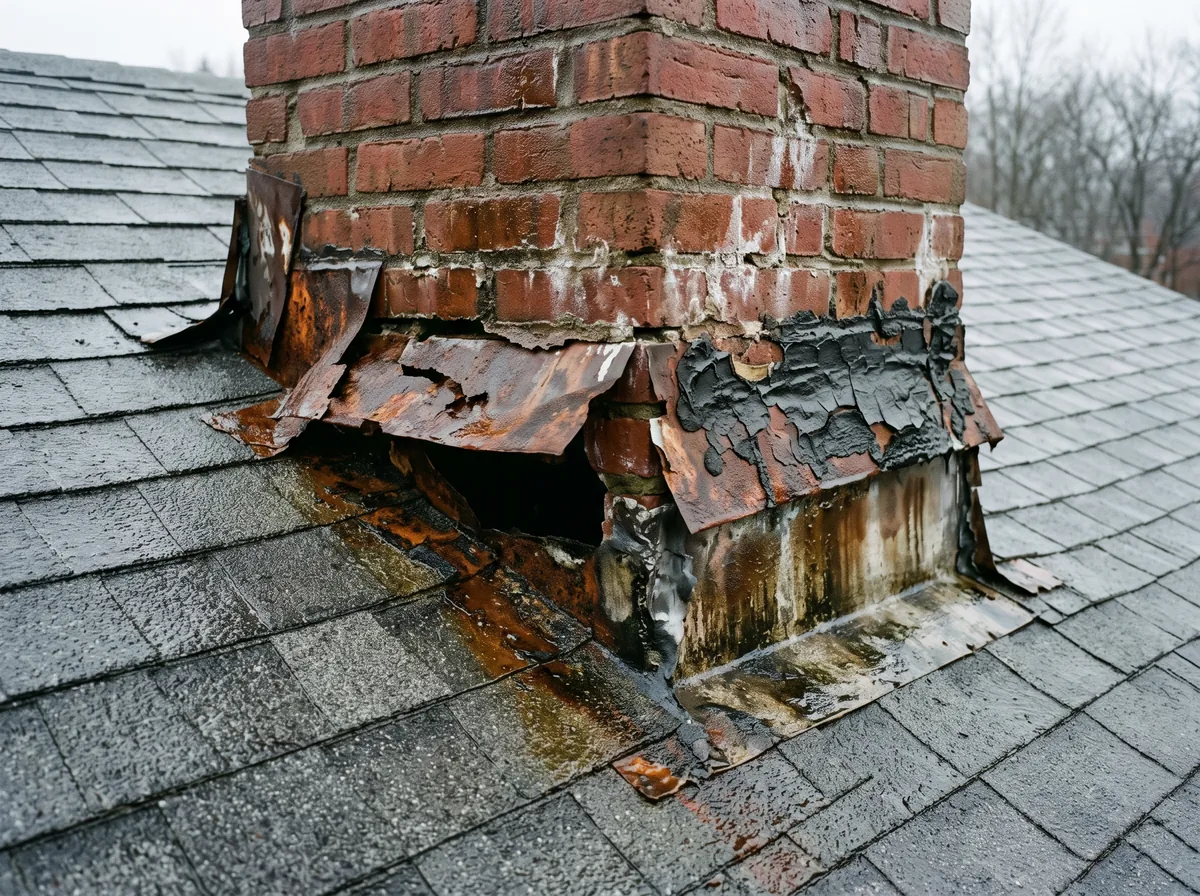
The call usually sounds the same. There is a brown stain on the ceiling near the fireplace, or a wet patch on the chimney breast, or water sitting in the firebox after a storm. Sometimes it has been there for two years and sometimes it arrived on Tuesday. What the homeowner wants to know is what it costs to fix.
That question cannot be answered honestly until someone establishes where the water is coming in, because a chimney leak has five possible sources and they are different repairs at different prices:
- Failed flashing at the junction where the chimney passes through the roof. This is the most common single cause of chimney water entry.
- A cracked or failed crown — the concrete slab across the top of the stack.
- Deteriorated mortar joints anywhere on the exposed masonry.
- Porous, unsealed masonry that is simply absorbing wind-driven rain faster than it can dry.
- A missing or damaged cap, letting rain and snow fall straight down the flue.
Every one of those produces a ceiling stain. Guessing between them is how people end up paying for a new crown and still having a wet ceiling in November, then paying for flashing in the spring. The diagnosis is the part worth paying for. The repair after it is mostly labour and sheet metal.
The timing of the water tells you most of what you need to know
Before anyone goes on the roof, there is information you already have, and it narrows the field considerably. Water behaves differently depending on which route it took to get inside, and the useful variable is when it appears.
Water that appears during rain, while it is still raining. That is a short, direct path from outside to inside, and the short path is almost always the roofline. Bulk water running down the roof hits the chimney, finds a gap in the flashing, and is inside the building envelope within seconds. If the stain darkens while the storm is happening and the drips track down near the roofline rather than the top of the stack, we start at the flashing.
Water that appears hours after the rain has stopped. That is a slow path through absorbent material. Water has landed on the top of the chimney, soaked into a cracked crown or run into open mortar joints, and is travelling downward through thirty feet of masonry before it reaches anything you can see. The delay is the diagnostic clue. A flashing leak does not wait; a crown or joint leak does.
Water that appears in cold weather with no rain at all. This one is not a leak, and it is the reason we ask. Moisture in flue gas condenses when it meets a flue surface below its dew point. That happens in an oversized flue, where gas moves too slowly and cools too much on the way up, and it happens in an unlined or poorly lined chimney where the masonry pulls heat out of the gas stream. The water is coming from the appliance, not from the sky. On the South Shore this shows up constantly in homes that converted from oil to gas without resizing the flue: a liner sized for a 200,000 BTU oil boiler now vents a 100,000 BTU gas boiler, the gas is cooler and wetter to begin with, and the condensate it produces is acidic and attacks the clay tile and mortar joints from the inside. No amount of flashing work fixes that. What fixes it is a correctly sized liner.
None of this is conclusive on its own, and we still get on the roof. But it determines where we look first, and it often explains a leak that two previous contractors could not find.
Flashing, in the detail that actually matters
Flashing is the metal waterproofing system at the junction between the chimney and the roof. It is not one piece and it is not caulk. It is four components that have to overlap in the correct order, and most flashing failures we see are a failure of that order rather than a failure of the metal.
Base flashing lies flat against the roof deck on the low side of the chimney and turns up the chimney face. It takes the water arriving down the roof slope and carries it out onto the shingles below.
Step flashing runs up the two sides of the chimney, where the roof slope means water is travelling along the stack rather than straight at it. It is not a single long piece. It is a series of individual L-shaped pieces, each one interleaved with a single course of shingles, so that every shingle course hands its water to the piece of metal below it. Step flashing installed as one continuous strip laid on top of the shingles will leak, because there is nothing to stop water getting underneath it.
Counter flashing is the piece that most often goes wrong. It is let into the mortar joints of the chimney — either bedded in the joint when the chimney was built, or set into a saw kerf cut into the joint — and it laps down over the top of the step flashing. Its whole purpose is to stop water running down the face of the brick and getting in behind the step flashing. When the mortar joint holding it erodes, the counter flashing loosens, the seal at the top edge opens, and water goes directly behind the entire system. This is the single most common failure point at the roofline.
The cricket, also called a saddle, sits on the high side of the chimney. On any chimney wide enough to matter, the upslope face forms a dam: water coming down the roof hits the back of the stack and has nowhere to go, so it pools there, sits against the masonry, and eventually gets in. A cricket is a small peaked structure built behind the chimney that splits that water and sends it around both sides. A wide chimney on a pitched roof with no cricket is a leak waiting for the right storm, and a great many South Shore chimneys were built or reroofed without one.
Flashing fails for four reasons, and they are worth knowing because they affect what the repair has to be. Metal rusts — galvanized and plain steel flashing has a finite life in this climate. Sealant shrinks and cracks, which is a matter of years, not decades. Wind lifts and deforms it. And a great deal of flashing was installed badly in the first place: a bead of caulk or roof cement smeared along the joint instead of properly interleaved metal. That last one is the most common thing we find, and it is also the most common thing a previous repair added. Caulk on its own is not flashing. It is a consumable that buys a season or two.
What you are likely to see, and what each sign points at
These are the symptoms in the order we usually hear them, with what they tend to mean.
- Water stains on the ceiling or wall near the fireplace. The starting point for everything. Note the timing against the rain and note whether the stain is highest near the roofline or spread down the breast.
- Water in the firebox after rain. Water that has come down the flue itself. Points at a missing or damaged cap, or at a crown cracked through at the liner collar. Distinct from water appearing in the firebox during cold weather with no rain, which is condensation.
- Rust stains on the back wall of the firebox, or a damper that no longer moves. Chronic water arriving down the flue over a long period. The damper rusting solid is often the first thing a homeowner actually notices.
- White chalky deposits on the exterior brick. Efflorescence — soluble salts carried out of the masonry by water passing through it and left behind as the water evaporates. It is a symptom, not the problem. It is direct evidence that water is moving through the chimney, and the entry point has to be found and fixed or it will keep coming back after cleaning.
- A damp or musty smell from the fireplace, particularly in summer. Saturated masonry inside the chase.
- Deteriorating paint or wallpaper near the chimney breast. Moisture inside the wall assembly, usually running for longer than anyone thinks.
Nor'easters and the exposed coastal towns
A leak that never appears in ordinary rain and then floods a ceiling in February is not a mystery. It is a flashing or masonry detail that copes with water falling downward and does not cope with water being driven horizontally.
In a nor'easter, rain arrives at the chimney sideways and under pressure for twelve to thirty-six hours at a stretch. Water is pushed up under lapped metal rather than running down over it, forced into open mortar joints on the windward face, and driven into brick faster than the masonry can shed it. Scituate is among the most storm-affected communities on the South Shore, and flashing and crown work there predictably spikes after a bad storm season. Hull, on a narrow peninsula with water on three sides, and the exposed stretches of Cohasset and the Plymouth waterfront behave the same way.
Two practical consequences. First, if your leak only shows up in storms, the repair has to be specified for wind-driven water — correctly interleaved metal, proper laps, a cricket where the chimney width calls for one, and sound joints on the windward face — not a heavier bead of sealant. Second, the repair cannot be done during the storm. Nobody should be on a pitched roof in a nor'easter, and any contractor who says otherwise is telling you something useful about their judgement. What a 24/7 phone line is genuinely for in that situation is getting buckets and towels under the water, telling you to close the damper and not light a fire, arranging emergency tarping if the roof penetration itself has opened up, and booking the first workable morning after the wind drops.
Why a leak does not stay the size it is
Water inside a chimney does not simply stain a ceiling and stop. It attacks mortar joints from behind, where you cannot see it happening. It saturates brick, and eastern Massachusetts crosses the freezing point roughly 80 to 110 times in a typical year — among the highest freeze–thaw exposure in the continental United States — so saturated brick freezes, the water in it expands by about nine percent, and the faces pop off. That is spalling, and once it starts the brick has lost its water resistance and takes on more water still.
Water also reaches the flue liner. It collects in the tile joints, and freezing cracks them. A cracked liner is a different category of problem from a wet ceiling, because the liner is what keeps combustion gases inside the flue. Once it is cracked, gas — including carbon monoxide — can migrate into the chimney structure and from there into wall cavities. With roughly 44 inches of annual precipitation, more along the coast, a joint or crown crack left open typically shows significant deterioration within three to five winters. This is not maintenance you are deferring. It is deterioration that is accelerating.
How we find the leak and what the repair involves
- We ask about timing before we touch anything. During rain, after rain, or cold weather with no rain. Where the stain is, how long it has been there, whether it tracks with storms specifically, and whether anything changed — a new roof, a new boiler, a gas conversion. This takes five minutes and it routinely halves the search.
- We inspect the flashing at the roof junction closely. We check whether the step flashing is genuinely interleaved with the shingle courses or laid over them, whether the counter flashing is still held in the mortar joints and still lapping the step flashing, whether the base flashing is intact and properly turned up, and whether there is a cricket on the high side where the chimney is wide enough to need one. We note every place a previous repair has been caulked, because caulk over a flashing defect hides the defect without fixing it.
- We check the other four entry points in the same visit. Crown cracks and delamination, the joint at the liner collar, open or sandy mortar joints on all four faces, the condition of the brick faces, and whether there is a cap and whether it fits. It costs nothing extra to look, and finding two entry points before the work starts is considerably better than finding the second one after you have paid for the first repair. We photograph all of it.
- Where the pattern says condensation, we scan the flue instead. If the water shows up in cold weather without rain, the productive next step is a camera down the flue and a look at what appliance is venting into it and at what input. An oversized or deteriorated flue serving a converted gas appliance is a liner problem, and we will tell you that rather than sell you flashing.
- Counter flashing re-seating and sealing, where the metal is sound. If the flashing system is correctly built and the failure is a loosened counter flashing and a perished seal, the right repair is raking out and re-seating the counter flashing in the joint and sealing it properly. This is the cheapest thing in this category and on a lot of chimneys it is the correct answer.
- Step flashing replacement, where the metal has failed. Rusted or deformed step flashing is replaced with new copper or aluminum, interleaved course by course with the shingles as it should have been. This means lifting shingle courses along the chimney sides, so it is more work than it looks from the ground.
- Full reflashing, with a cricket where one is needed. Where the system was never built correctly, or where the chimney is wide and has no cricket, the repair is the whole assembly: base, steps, counter flashing let into the joints, and a framed and flashed cricket on the high side so water is split and carried around the stack rather than pooling behind it. On a chimney that has leaked through every storm for years, this is usually what it takes.
- We deal with the source, not the stain. Once water entry has stopped, efflorescence can be cleaned and interior finishes can be repaired. Doing either first is wasted work. If the diagnosis points at the crown, the joints or the masonry face rather than the roofline, we say so and quote that work — crown repair, repointing, or waterproofing — rather than reflashing a roof that is not the problem.
What this costs on the South Shore
These are realistic Eastern Massachusetts ranges, published so you can sanity-check any quote you are given — including ours. What moves the number is the extent of the metal work and the access: roof pitch, chimney height, whether a ladder will do, how many shingle courses have to be lifted, chimney width and therefore whether a cricket is required, and the roof covering itself. Slate and cedar cost more to open and close than asphalt. The top range applies where the shingles around the chimney are at the end of their life and have to come off and go back rather than being lifted and relaid. If the leak turns out to be the crown, the joints or the masonry face, you are looking at crown, repointing or waterproofing pricing instead, which is a different and often lower set of numbers.
The repair that gets done twice
The expensive pattern goes like this. There is a stain. A contractor looks at the chimney, sees a crown that is visibly cracked — because most crowns on older South Shore chimneys are visibly cracked — and rebuilds it. The crown genuinely needed doing. The leak was at the flashing. The stain comes back with the next storm, and now there is a second quote.
It works the other way too. Flashing gets replaced on a chimney whose real problem is that the mortar joints on the windward face are open and the brick is drinking storm rain. New metal at the roofline, same wet ceiling.
Neither contractor was dishonest. Both skipped the diagnosis. The way to avoid it is to insist that whoever quotes you states which of the five entry points they believe is leaking, on what evidence, and what they found at the other four. If a quote arrives without that, it is a price for a repair, not an answer to your problem. It is also entirely possible for two of the five to be live at once on an older chimney, and knowing that before the work starts is what lets you sequence it sensibly instead of paying twice for staging.
Local patterns worth knowing before anyone quotes you
Reroofing and flashing. A great many chimney leaks on the South Shore date from a reroof. Shingles are the roofer's work and the chimney is the mason's, and the flashing sits exactly on that line. Where the counter flashing was reused rather than reset, or the step flashing was laid over the new shingles rather than woven into them, or the cricket that was there before was not rebuilt, the leak starts within a year or two of a roof that is otherwise sound. If your leak began after a reroof, say so — it changes where we look and it may change who is responsible.
Multi-flue stacks on two-families and three-deckers. Much of Quincy and North Plymouth was built out between roughly 1895 and 1940 with two-family and triple-decker housing, and those chimneys are wide, carrying several flues in one stack. Wide stacks are exactly the ones that need a cricket on the upslope side, and they frequently do not have one. They also present more linear feet of flashing and more mortar joints to the weather than a single-flue chimney, which is why a leak quote on a triple-decker is not the same number as a leak quote on a ranch in Abington.
Coastal exposure. Properties close to the water — most of Hull, much of Scituate, waterfront Cohasset, North Plymouth and Quincy's Houghs Neck, Squantum and Marina Bay — carry salt in the masonry pores as well as water. Salt crystallising in the pores fractures brick faces independently of freezing, and it does it year round. Mortar joints in those locations may need attention every 8 to 12 years rather than the 15 to 20 typical of inland South Shore towns, which means the joint-related entry points come round faster near the coast than they do in Hanover.
When a leak is urgent and when it is a Tuesday job
Most chimney leaks are not emergencies. They are damage accumulating at a rate measured in winters, and the right response is a proper diagnosis and a scheduled repair.
Some are urgent. If masonry has come down onto the roof, if the chimney is visibly leaning, or if there is an open hole in the roof where the chimney penetrates it, that is immediate structural and weather exposure and it warrants a call whenever it happens. Keep people away from the area below the stack, inside and out. If water is actively pouring in during a storm, put buckets and towels in the firebox, close the damper if it is open, and do not light a fire — a fire in a saturated flue is a separate problem.
Two things move a leak call into a different category altogether. If a carbon monoxide alarm sounds, or anyone in the house has a headache, dizziness, nausea, confusion or unusual fatigue, leave the house with everyone in it and call 911 from outside. Do not silence the alarm and stay indoors, and do not assume it is false. And after any chimney fire, the chimney should not be used at all until it has been inspected, because thermal shock cracks liner tiles whether or not the outside looks any different. In both cases the chimney work follows the emergency services, it does not replace them.
What people ask about this job
How do I know whether my chimney is actually leaking?
The usual signs are water stains on the ceiling or wall above the fireplace, water visible in the firebox after rain, rust stains on the back wall of the firebox, white efflorescence staining on the exterior brick, a damp or musty odour from the fireplace, and paint or wallpaper deteriorating near the chimney breast. The important distinction is between a leak, which appears during or shortly after rain, and condensation, which appears in cold weather with no rain. They look similar on a ceiling and they have completely different causes and repairs.
Is flashing repair a roofer's job or a chimney company's job?
It sits on the boundary, which is exactly why it leaks so often. The flashing has to be interleaved with the roof covering, which is roofing work, and the counter flashing has to be let into and sealed in the chimney's mortar joints, which is masonry work. Done properly it needs both understood together. What causes trouble is when one trade treats the other's half as somebody else's problem — reused counter flashing after a reroof, or a bead of caulk where interleaved metal was needed.
Can't we just caulk it?
Sealant has a real role: bedding counter flashing into a mortar joint and sealing that top edge. What it cannot do is substitute for the metal. Caulk-only flashing — a bead smeared along the roof-to-chimney junction with no properly lapped step and counter flashing behind it — is one of the most common defects we find, and it is frequently the result of a previous repair. Sealant shrinks and cracks within a few years, and in the meantime it hides the defect it is sitting on. If your leak has been caulked twice already, the third bead is not the answer.
What is a cricket and does my chimney need one?
A cricket, also called a saddle, is a small peaked structure built on the upslope side of a chimney to split water coming down the roof and carry it around both sides of the stack. Without one, a chimney wide enough to act as a dam causes water to pool against its back face, where it sits until it finds a way in. Whether yours needs one depends on the chimney's width across the slope and the pitch of the roof. Wide multi-flue stacks — the kind on two-families and triple-deckers — are the classic case, and many of them do not have one.
Water only comes in during nor'easters. Is that still a leak?
Yes, and it is a specific kind. Ordinary rain falls downward, which lapped metal and sound masonry handle. A nor'easter drives water horizontally under pressure for many hours, pushing it up under laps and into any open joint on the windward face. Storm-only leaks generally mean the assembly is marginal rather than absent, and the repair has to be specified for driven water rather than just resealed. The repair itself has to wait for workable weather — nobody should be on a pitched roof in high wind.
Will my homeowners insurance cover a chimney leak?
Usually not, though it depends on your policy. Homeowners policies generally cover sudden and accidental damage — a tree coming down, a lightning strike, identifiable storm damage — and generally exclude gradual deterioration and wear, which is what rusted flashing, perished sealant and eroded mortar joints are. Where a claim can succeed is when damage happened on a specific date, so dated photographs and a written inspection report are worth having. We document what we find either way. Whether it is covered is between you and your insurer.
Often needed alongside this
Chimney Crown Repair
The concrete slab on top is the first thing our winters destroy, and the first thing that lets water into the brick below.
Read more →Chimney Waterproofing
A vapour-permeable repellent that stops wind-driven rain soaking into the masonry, without trapping moisture inside it.
Read more →Caps & Dampers
Keep rain, snow and animals out of the flue, and stop heated air escaping up it all winter.
Read more →Get the leak diagnosed before it is repaired twice
Tell us what you are seeing and we will tell you what it is likely to be, what it will take to fix, and roughly what it should cost — before anyone climbs on your roof.
Prefer to talk it through? The phone is answered around the clock, by a person, including during storms.
We work across Quincy, Braintree, Weymouth, Hingham, Milton, Hull, Cohasset, Scituate, Norwell, Marshfield and the rest of the South Shore.