Spalling brick & rebuilding
Chimney rebuilding and spalling brick repair
Rebuilding is the expensive end of chimney work, and most of the chimneys we rebuild did not have to get there. Spalling brick is water damage, and water damage is cumulative.
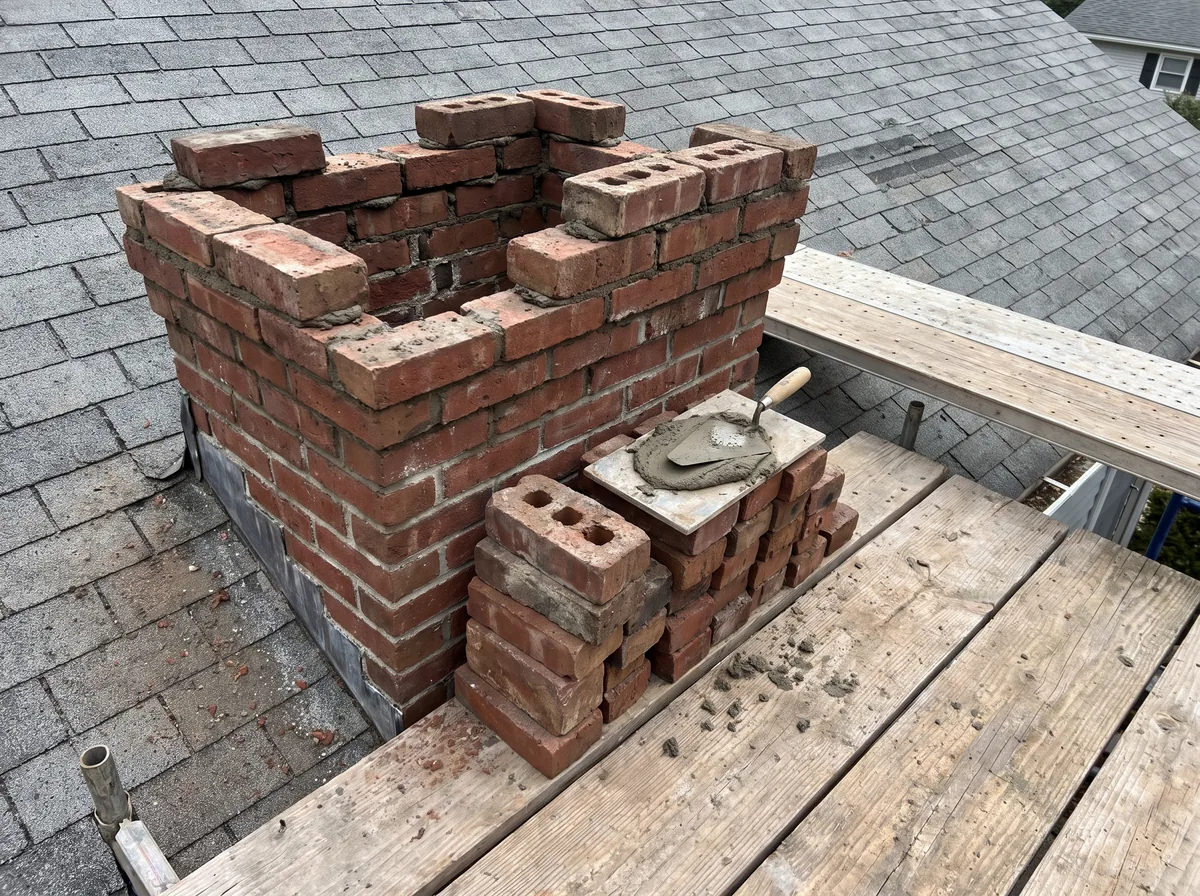
Spalling is the fracturing and loss of the face of a brick. You will see it as pock marks, as flakes and plates of brick lying on the roof or in the gutter, as red or orange grit at the base of the chimney, and as bricks whose smooth fired surface has gone and left a rough, open, sandy face behind.
The mechanism is simple. Brick is porous. It absorbs water. When a saturated brick drops below freezing, the water inside it expands by roughly nine percent, and because it has nowhere to go it exerts pressure outward from inside the pore structure. The weakest plane is just behind the fired outer skin, so the skin pops off. That is a spall.
What makes it self-accelerating is what the fired face was doing. The outer skin of a brick is its dense, low-absorption, weather-resisting layer — the part of the unit that was in the hottest part of the kiln. Behind it the brick is considerably more porous. Take the face off and you have exposed a sponge to the weather. That brick now absorbs several times as much water as it did, so it freezes harder, spalls deeper, and saturates the mortar and brick around it. One spalled brick in a chimney is a maintenance item. Six spalled bricks in the same square foot is a chimney in decline.
Eastern Massachusetts is close to a worst case for this. The region crosses the freezing point roughly 80 to 110 times a year — among the highest freeze–thaw exposure in the continental United States — with about 44 inches of annual precipitation, more on the coast. Every one of those crossings is an opportunity, and a brick only has to be wet at the wrong moment.
The coastal mechanism that does not need a freeze
There is a second process running on chimneys near the water, and it is the one nobody explains to homeowners.
Air off Massachusetts Bay and Boston Harbor carries sodium chloride and other salts. Wind-driven spray and salt-laden fog deposit those salts on masonry, and water carries them into the pore structure of the brick. Inside the pores the salt cycles: dissolved when the masonry is wet, crystalline as it dries. Salt crystals occupy more volume than the dissolved salt did, and when they form inside a confined pore they generate crystallisation pressure against the pore walls. Enough cycles and that pressure fractures the brick from within and pushes the face off. When the salt deposits below the surface rather than on it, the process is called subflorescence — the destructive cousin of the harmless white efflorescence you see on the outside of a damp chimney.
The important point is that this needs no freeze. It runs on wetting and drying alone, which means it works in July as readily as in February. A coastal chimney is therefore being attacked on two independent schedules: the freeze–thaw cycle all winter, and salt crystallisation all year. This is additive damage, not alternative damage, and it is why masonry in Hull, Squantum, Houghs Neck, Quincy Point, Scituate Harbor, waterfront Cohasset, Manomet, White Horse Beach and the North Plymouth shoreline deteriorates measurably faster than identical masonry eight miles inland in Hanover or Abington.
Practically, it means two things. Coastal chimneys need looking at on a schedule rather than on symptoms, and a coastal chimney that is spalling is unlikely to stop spalling on its own once the weather turns. It also means waterproofing earns its keep here more than anywhere else, because a penetrating repellent that keeps the brick drier starves both mechanisms at once.
Where spot repair stops and rebuilding starts
Not every spalled brick means a rebuild. The honest threshold is about density, depth and position.
Spot replacement is the right answer when the damage is a scatter of individual bricks across an otherwise sound stack, when the spalling is confined to the face rather than having eaten into the body of the unit, and when the mortar joints around them are still holding. The damaged units are cut out individually and replaced, the surrounding joints are pointed, and the chimney carries on.
It escalates to a rebuild when the spalling is continuous across courses rather than scattered, when bricks have lost enough body that there is nothing sound to bed a replacement against, when the joints have gone along with the faces so the stack has lost its bond, when the chimney has any visible lean or bulge, or when so many units need replacing in one area that cutting them out individually would destabilise what is left. There is a practical crossover point too: once you are replacing most of the brick in a section, taking that section down and rebuilding it is faster, cheaper and structurally better than stitching it.
A leaning chimney is a separate category and should be treated as urgent. A stack that has separated from the house structure or is visibly out of plumb is a collapse hazard, the fireplace or appliance served by it should not be used, and the area below it on the exterior should be kept clear until somebody has looked at it.
Rebuilding above the roofline
The most common major chimney repair in Eastern Massachusetts is the rebuild of the section above the roof, and the reason is geometric rather than mysterious.
Below the roofline a chimney is partly protected: it is inside the building envelope or shielded by it, it stays warmer, it is not taking wind-driven rain on four sides, and it is not sitting directly under a failing crown. Above the roofline it has no protection at all. So the damage is very often sharply divided, with badly deteriorated masonry above the flashing line and structurally sound masonry below it.
That division is good news. It means the repair can be a defined piece of work — take the stack down to sound masonry at or just below the roofline, then rebuild upward — without touching the chase running through the house, without interior demolition, and without re-engineering anything the chimney carries. The scope is normally the top three to five feet for a partial rebuild, or everything above the roof for a full above-roofline rebuild, and it includes a new crown because you would be mad to rebuild a stack and reuse the crown that destroyed the last one.
Full demolition and rebuild from the footing is a different scale of project. It applies where the chimney is deteriorated through its height, where the foundation or lower structure has failed, or where the chimney has moved. It involves staging, interior access, structural support for anything the chimney carries, and it runs into five figures. It is rare, and any contractor reaching for it should be able to show you why the cheaper repair will not work.
Matching brick, and why it is harder than it sounds
Replacement brick has to match the original in size, colour, texture and — less obviously and more importantly — in hardness and absorption.
Size is the first constraint people miss. Brick dimensions have changed over the last century and a half, and nineteenth-century brick is frequently not the same module as anything currently manufactured. Dropping a modern brick into a hundred-year-old wall means either a joint that is visibly wrong or a course that does not line up.
Colour and texture are what you actually see. Period brick was fired unevenly in clamp and beehive kilns, so a historic wall has variation in it that a uniform modern brick cannot reproduce; matching usually means a blend rather than a single unit. The options are salvaged brick of the right period and region, which is the best match and takes time to source, or a period-appropriate replacement brick selected against the original.
Hardness matters for the same reason mortar hardness matters. A dense modern brick set among soft historic brick in soft mortar becomes the hard point in the wall, and the stress it does not absorb goes into its softer neighbours. On Plymouth's antique stock and Quincy's turn-of-the-century two-families this is a real consideration rather than a theoretical one, and it is worth asking what is being specified.
How a rebuild is actually done
- We establish how far down the damage goes. The first job is finding sound masonry. We work down the stack tapping and probing, checking joints as well as faces, and establish the line below which the chimney is genuinely intact. That line sets the scope and therefore most of the price, so we photograph it and show you. A quote for a full rebuild on a chimney that needs three feet taken off is a quote worth questioning.
- We scan the flue before anything comes down. A camera run down the flue tells us whether the liner is intact. This has to happen before the rebuild rather than after, because if the liner needs replacing it is enormously cheaper to do it while the stack is open than to reline through a chimney you have just finished rebuilding. Crown failure, masonry failure and liner damage travel together often enough that we assume nothing.
- We set up access. Most rebuilds need staging rather than a ladder, both for safety and because you cannot lay brick properly off a ladder. The roof gets protected, because dismantled masonry will break slate and tear asphalt, and a debris path off the roof is set up before the first brick moves.
- We take it down course by course, salvaging what is sound. Demolition is controlled rather than enthusiastic. Bricks come down in courses, and undamaged units are cleaned of old mortar and kept, because salvaged original brick from your own chimney is the best possible match for the brick going back on it. On historic properties this is often the difference between a rebuild that reads as original and one that reads as a repair.
- We deal with the liner while the chimney is open. If the clay tile is sound it is preserved and built around. If it is cracked, displaced or has been taking acidic condensate from a gas appliance, this is the moment to install a new liner — the work is a fraction of what it costs as a standalone job once the stack is closed up. See liner installation for how that is specified and sized.
- We rebuild in matched brick and matched mortar. Salvaged or period-appropriate brick, laid in mortar matched to the era of the original construction — Type N or lime on pre-1940 work, not Type S because it is stronger. Course heights and joint profile follow the surviving masonry below. The corbel or crown detail at the top is rebuilt as designed rather than simplified away.
- We cast a proper crown and reinstate the cap and flashing. A new crown in polymer-modified mix, with a real overhang past the face of the brick, a correct slope, and a bond break at the flue collar so the liner can move independently. A stainless cap over the flue. Counter flashing re-seated into the new joints rather than caulked to the face. These details are why the rebuilt chimney should outlast the one it replaced.
- We protect the cure and clean up. Fresh masonry at height wants temperatures consistently above about 40°F and protection from driving rain and hard sun while it gains strength. We watch the forecast rather than the calendar, and the roof and grounds are cleared of masonry debris before we leave.
What this costs on the South Shore
Published Massachusetts rebuild figures span roughly $1,000 to $15,000 for the great majority of jobs, with ground-up work above that, and the ranges here sit inside that picture. What moves the number is the height of the rebuilt section, the number of flues in the stack, access and staging, roof pitch, whether the liner is being replaced at the same time, and the brick specification — salvaged period brick costs real money and takes time to source. A partial above-roofline rebuild is typically one to three days on site. A full demolition and rebuild from the footing is a project measured in weeks, involves interior work, and may require structural support for loads the chimney carries.
The uncomfortable arithmetic
We will be straightforward about this, because it is the most useful thing on this page.
A chimney does not arrive at a rebuild suddenly. It gets there along a path that is visible for years, and every stage of that path is cheaper than the next one. Sealing a cracked crown is a few hundred dollars. Repointing the top courses is a few hundred more. Repointing a whole chimney is usually under two thousand. Replacing the section above the roofline starts at fifteen hundred and runs to eight thousand. Rebuilding from the footing is five figures.
The mechanism that moves a chimney down that path is always water, and the three things that let water in are a failed crown, open mortar joints and failed flashing. All three are visible from the ground with binoculars, and all three are cheap to fix relative to what they cause. Three to five winters of an unaddressed crown or open joints, in a climate with 80 to 110 freeze–thaw cycles a year, is very commonly the whole story behind a rebuild quote.
If you are reading this because your chimney is already spalling, that advice is late for this stack but not for the repair. Rebuild it correctly — matched mortar, proper crown, real cap, sound flashing, and waterproofing on a coastal property — and you should not be having this conversation again. Rebuild it with the same details that failed last time and you have bought thirty years at best.
Rebuilds on older and historic South Shore chimneys
Two local situations come up repeatedly and both change the job.
Multi-flue stacks on two-families and triple-deckers. Much of Quincy — Wollaston, North Quincy, West Quincy — and North Plymouth was built out between roughly 1895 and 1940 with two-family and three-decker housing, and those chimneys often carry several flues in one stack, historically one per unit plus the heating appliance. Rebuilding one of these means rebuilding around multiple liners, maintaining the separation between them, and forming a crown with a correct bond break at every collar. It is materially more work than a single-flue stack. It is also the moment to confirm that appliances are not cross-venting between flues, which is a real risk in shared stacks and is worth checking while everything is open.
Antique and pre-1800 construction in Plymouth. Plymouth has the highest concentration of pre-1800 structures of any South Shore community. Chimneys of that era may be fieldstone or rubble rather than brick, laid in lime mortar throughout, with flues that predate tile lining entirely and were built to serve open cooking hearths rather than any modern appliance. They are often large — many flues from many fireplaces in one massive stack — which makes them expensive but not technically difficult to repair where they are accessible. On listed or contributing properties in the Plymouth Center Historic District, work may require review under the State Historic Preservation Office, and that needs establishing before anything is dismantled rather than after.
What people ask about this job
What actually causes bricks to flake off a chimney?
Water. Brick is porous and absorbs it; when a saturated brick freezes, the water expands by roughly nine percent and pops the fired face off from behind. That is spalling. On coastal South Shore properties there is a second cause: salt carried in off the water crystallises inside the pores of the brick and fractures it from within, which needs no freeze at all and runs year-round. Both are moisture problems, which is why the durable fix always involves finding out where the water is getting in — crown, joints or flashing — rather than just replacing brick.
Can spalled bricks just be replaced individually?
Often, yes. Where the damage is scattered individual units on an otherwise sound stack with intact joints, cutting them out and replacing them is the right repair and runs about $50 to $150 per brick installed. It stops being the right repair when the spalling is continuous across courses, when the bricks have lost enough body that there is nothing solid to bed a replacement against, when the joints have failed along with the faces, or when the number of units needing replacement in one area is high enough that removing them would destabilise what is left. Past that point a partial rebuild is both cheaper and structurally better.
Can you rebuild just the part above the roof?
Yes, and it is the most common major chimney repair in Eastern Massachusetts. The masonry above the roofline takes weather on four sides with no protection, while the chase below stays comparatively sheltered, so damage is frequently confined to the exposed section. Rebuilding from the roofline up avoids interior demolition entirely and keeps the job to a defined scope. The scan of the flue and the condition of the masonry just below the flashing line determine whether that is genuinely enough.
Will the new brick match the old?
Closely, usually, but be realistic. We salvage and reuse sound brick off your own chimney first, which is the best match available. Beyond that the options are reclaimed period brick of the right region and vintage, or a modern brick selected against the original for size, colour and texture. Nineteenth-century brick was fired unevenly and has variation in it that uniform modern brick cannot reproduce, so matching usually means blending. A rebuilt section on an old chimney will normally read slightly newer for a few years and then weather in.
Do I need to replace the liner at the same time?
Only if the liner needs it — but you want to know before the stack goes back up, not after. We run a camera down the flue before demolition. If the clay tile is sound it is preserved and built around. If it is cracked, displaced, or has been taking acidic condensate from a gas appliance it should be replaced while the chimney is open, because the same work costs substantially more as a separate job later. If the chimney serves a gas appliance that was converted from oil, assume the liner needs attention until a scan proves otherwise.
Is a leaning chimney an emergency?
Treat it as one. A chimney that is visibly out of plumb, bulging, or has separated from the house structure is a collapse hazard, and above a roof it is a hazard to the roof and to anyone below it. Stop using the fireplace or any appliance vented into it, keep people away from the ground below it on the outside, and get it looked at rather than watching it through another winter. Leaning is not a cosmetic symptom — it means the structure or the footing has failed, and that is rarely something that stabilises on its own.
Often needed alongside this
Repointing & Tuckpointing
Mortar is meant to fail before the brick does. When the joints go sandy, water goes straight into the chimney core.
Read more →Chimney Crown Repair
The concrete slab on top is the first thing our winters destroy, and the first thing that lets water into the brick below.
Read more →Liner Installation & Relining
Cracked clay tile, or an oil-era flue now venting a gas boiler — the most common serious defect we find on the South Shore.
Read more →Find out whether it is a repair or a rebuild
Tell us what you are seeing and we will tell you what it is likely to be, what it will take to fix, and roughly what it should cost — before anyone climbs on your roof.
Prefer to talk it through? The phone is answered around the clock, by a person, including during storms.
We work across Quincy, Braintree, Weymouth, Hingham, Milton, Hull, Cohasset, Scituate, Norwell, Marshfield and the rest of the South Shore.