Caps, dampers & chase covers
Chimney caps and dampers across the South Shore
A cap keeps weather and animals out of the flue. A damper closes the flue when it is not in use. They sit at opposite ends of the same chimney, they fail for different reasons, and one modern component does both jobs.
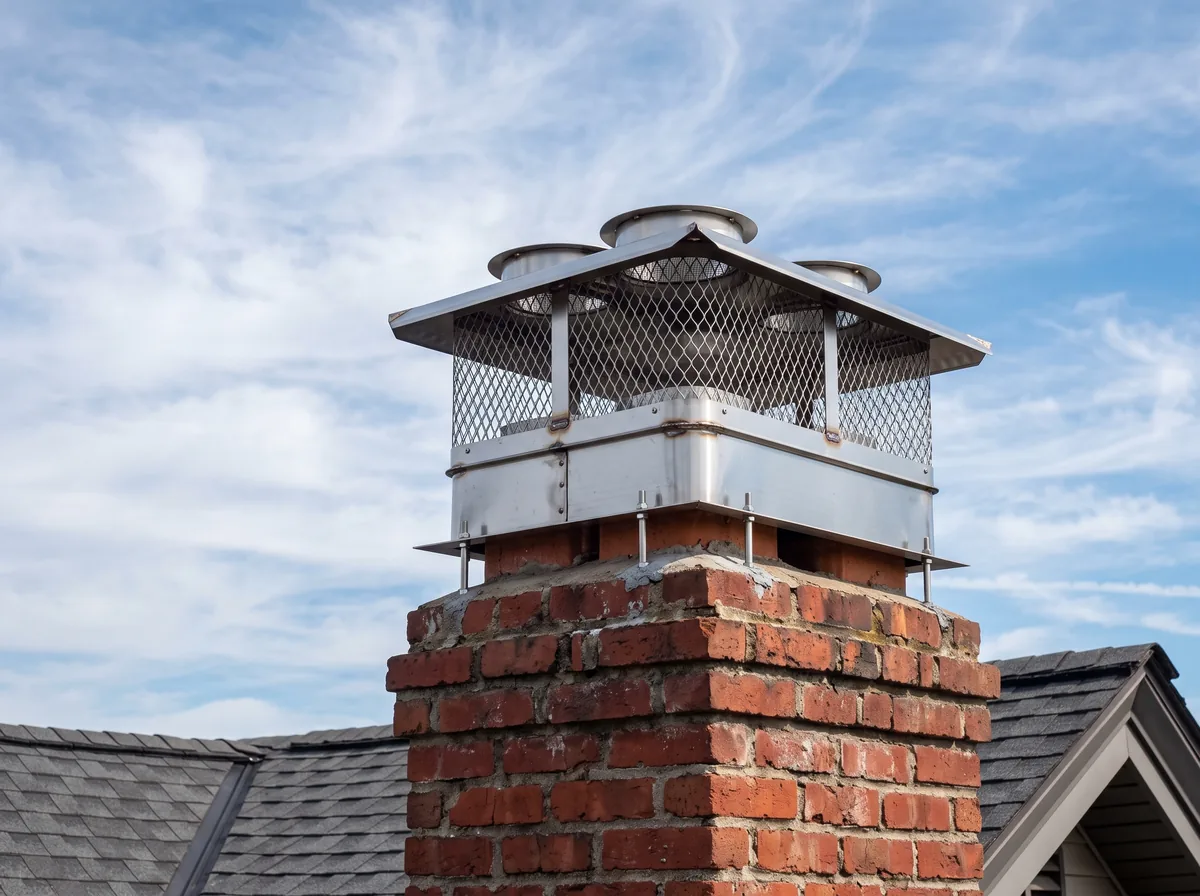
These are the two cheapest components on a chimney and between them they prevent a disproportionate share of the expensive problems. An uncapped flue in this climate takes rain and snow directly down its throat, where the water sits on the smoke shelf, rusts the damper solid, soaks into the liner joints and freezes there. A damper that no longer closes leaves a permanent hole from your living room to the sky.
They also get confused with each other, and with the crown, in a way that produces genuinely misleading quotes. The crown is the concrete slab across the top of the masonry. The cap is the metal cover over the flue opening that pokes through it. The damper is the closure that stops air moving through the flue, and it lives either just above the firebox or — in the modern version — at the very top of the chimney. If a quote says 'cap' and you were expecting a new crown, or says 'damper' without saying which kind, get that clarified before you sign anything.
What a chimney cap does, and how it should be sized
The cap sits over the flue opening and keeps four things out: rain, snow, animals and debris. In the Northeast the water is the expensive one. A chimney without a cap experiences accelerated interior deterioration because every storm puts water directly onto the liner joints and down onto the damper and smoke shelf, and every hard freeze afterwards works on it. Both the CSIA and NFPA recommend caps on all chimneys, and there is no serious argument against one.
Sizing is the detail that gets skipped. The cap must clear the flue liner opening by at least one inch on all sides. That gap is the path the exhaust actually takes on its way out, and a cap set too close to the liner, or a mesh too fine, restricts the draft — which shows up as a smoky fireplace that the homeowner blames on everything except the part that was just installed. A cap is not a generic accessory: it is sized to the liner it covers, and on an irregular or oversized clay liner it may need to be fabricated rather than pulled off a shelf.
Most caps carry a mesh screen, which does two jobs. It excludes birds and squirrels, and it acts as a spark arrestor, catching embers that would otherwise leave the flue and land on the roof. Five-eighths of an inch or smaller mesh is the standard specification for animal exclusion, and it will stop everything except a determined raccoon at an unprotected opening.
Where a chimney carries several flues in one stack — standard on the two-family and triple-decker housing across Quincy and North Plymouth, where each unit historically had its own flue alongside the heating appliance — the usual answer is a single multi-flue cover spanning the whole crown rather than individual caps on each liner. It sheds water off the crown as well as the flues and there is one set of fixings rather than four.
Cap materials, ranked honestly
There are three common materials and the difference between them is service life, not performance on day one.
- Galvanised steel. The cheapest and the shortest-lived. The zinc coating sacrifices itself to protect the steel underneath, and once it is consumed the cap rusts. It is what turns up on builder-grade installations and on prefabricated systems as supplied.
- Aluminium. Will not rust, and lighter, but softer — more easily deformed by weather, ice and the occasional branch. A reasonable middle option.
- Stainless steel. The right specification for this region and what should be quoted for any new installation. It costs more and it is the last cap most chimneys will need.
The material choice matters more the closer you are to the water. Salt-laden air off Massachusetts Bay and Boston Harbor is corrosive year-round, and it does not wait for winter. Properties within roughly a quarter mile of the coastline — most of Hull, much of Scituate and Cohasset, Houghs Neck, Squantum, Quincy Point and the North Plymouth waterfront — see measurably accelerated deterioration of masonry and metal alike. A galvanised cap in Houghs Neck is a short-term purchase. Stainless is the specification that makes sense there, and the price difference is small enough that it is worth paying inland too.
Throat dampers: the traditional plate, and why it fails
The throat damper is the cast-iron or steel plate set into the throat of the firebox, just above the opening, operated by a handle or a lever. Open it to use the fireplace, close it when the fire is out. Essentially every masonry fireplace built before the last few decades has one.
Its weakness is that it was never an air seal. It is a metal plate resting against a metal frame, and even brand new, straight and clean, it leaks. It was designed to stop the worst of the draft, not to seal the flue, and there is no gasket anywhere in the assembly.
Then it ages. The damper sits directly under an uncapped or poorly capped flue, which means it catches rainwater and condensation and rusts. It also takes the full heat of every fire, and metal that is heated and cooled repeatedly warps. A rusted, warped plate does not seat. At that point the fireplace is a permanently open duct between your heated house and the outside air, pulling conditioned air up the flue in winter and letting humid air down it in summer.
Repair, where the mechanism is simply seized or the handle has failed, runs $150 to $400 and is worth doing. Replacement is the harder question. In many older masonry fireplaces the original damper frame was mortared into the brickwork when the fireplace was built, and it cannot be taken out without breaking masonry apart around it. Access through the firebox opening is tight, overhead and awkward. That is why, on a great many older South Shore fireplaces, replacing the throat damper in kind is impractical — and why the sensible answer is usually to leave it where it is and put the seal at the other end of the chimney.
Top-sealing dampers: a seal rather than a plate
A top-sealing damper is a cap and damper in one assembly, mounted at the top of the chimney on the flue, with a silicone or rubber gasket around its lid. A stainless cable runs down the flue to a handle or bracket in the firebox, so you open and close it from inside the house exactly as you would a throat damper.
The difference is the gasket. When closed, the lid compresses onto it and the flue is genuinely sealed, rather than mostly obstructed. That matters more than it sounds. A fireplace flue is a vertical shaft from the warmest part of your house to the coldest air outside, and stack effect pulls heated air up it continuously through the heating season. A leaky throat damper does very little about that. A gasketed seal at the top of the chimney stops it, and stops the reverse in summer when humid outside air runs down a cold flue and brings the damp fireplace smell with it. CSIA and energy efficiency organisations recommend top-sealing dampers for exactly this reason.
Because the assembly sits over the flue opening, it also does the cap's job: rain, snow, birds, squirrels and debris are all excluded whether the damper is open or shut. You are buying one component that closes two gaps.
At $250 to $550 installed, this is the best value upgrade available on an older home whose throat damper has corroded, warped, or was removed at some point and never replaced — which is common in fireplaces converted from coal grates. Rather than break out masonry to fit a new plate that would leak anyway, you fit a component that seals properly and excludes animals at the same time.
How the work is done
- We measure the flue, not the chimney. Caps and top-sealing dampers are sized to the liner opening, so the first job is measuring the actual clay tile or metal flue at the top — each one of them on a multi-flue stack, because they are frequently different sizes. We check that the planned cap will clear the opening by at least an inch on every side so the draft is not restricted.
- We check what the flue serves before recommending a damper. This determines what can legally and safely be fitted. A flue serving an open fireplace can take a top-sealing damper. A flue serving a gas or oil appliance cannot — those flues must remain clear of obstruction, and the correct component there is a cap alone.
- We look at the crown at the same time. The cap is fixed at the top of the chimney, which is where the crown is, and a crown that has cracked through or is losing material is not a sound base to work off. If it needs attention it is far cheaper to do it in the same visit than to have someone back up there in six months. That is a crown repair conversation and we will say so rather than fitting a cap over a failing slab.
- Installation: clamped, not caulked. A single-flue stainless cap is secured to the liner with a clamp band, or to the crown with masonry fixings on an outside-mount design. A multi-flue cover is fabricated to the crown dimensions and anchored to the masonry. What you do not want is a cap held on with sealant alone; it will move in the first winter nor'easter.
- Top-sealing damper: cable run and adjustment. The damper assembly is mounted to the flue at the top, the stainless cable is dropped down the flue and fixed to a bracket inside the firebox, and the tension is set so the lid pulls down fully onto its gasket. It is adjusted and tested open and closed before we leave, because a cable set too slack seals badly and a cable set too tight is awkward to operate.
- Chase covers are fabricated to the chase. On a prefabricated chimney the cover is made to the measured dimensions of the chase top in stainless or painted aluminium, with a cross-break or drain channels formed into it so water runs off rather than ponding in the middle. A flat cover with no fall is what failed in the first place.
- We confirm the draft afterwards. On a fireplace, the last check is that the flue still drafts properly with the new component on it. A cap that restricts the opening or a mesh that is too fine will produce a smoky fireplace, and it is better to find that out while there is still a ladder against the house.
What this costs on the South Shore
These are realistic Eastern Massachusetts ranges, published so you can check any quote against them — including ours. Material and size move the cap number: stainless costs more than galvanised and lasts several times longer, and a custom multi-flue cover fabricated to a crown is a different product from a stock single-flue cap. Access moves everything: chimney height and roof pitch decide whether a ladder will do or the job needs staging. Cap and damper work is frequently combined with a sweep or an inspection, which is the sensible way to buy it, since somebody is on the roof either way.
Chase covers on prefabricated chimneys
Not every chimney on the South Shore is masonry. A factory-built or prefab chimney is a metal flue system running inside a framed wooden chase, usually finished to match the house. It has no crown, because there is no masonry. What seals the top of the chase is a sheet-metal chase cover, and it does the crown's job.
The covers supplied with these systems as standard are galvanised steel, and in the Northeast climate they typically rust through within five to fifteen years. When that happens the water does not run off the chimney; it goes straight into the chase cavity, where it soaks the framing. Rotted chase framing is a much larger bill than a cover, and it is usually discovered only when somebody finally goes up to look at the rust stains running down the siding.
The tells are rust staining on the cover or the siding below it, standing water on the cover after rain, a visibly dished or sagging top, and water or damp odour in the firebox. The replacement is a custom-fabricated cover in 304 or 316 stainless steel, or painted aluminium, made to the measured chase dimensions and formed with a centre cross-break or drain channels so water sheds instead of pooling. That runs $350 to $900; framing repair, if rot is found underneath, is additional and cannot be quoted before the old cover comes off.
This is the dominant chimney service need in particular parts of the South Shore rather than a niche one. The post-war and contemporary housing in Merrymount, Adams Shore and Marina Bay in Quincy, and in Manomet on Plymouth Bay, uses prefabricated systems far more than historic masonry. If your chimney is a clad box rather than brick, chase cover and cap replacement is your version of crown repair.
Animals, exclusion, and the one case where capping is illegal
An open flue is a sheltered vertical cavity, which is exactly what several species are looking for. A correctly sized stainless cap with mesh is the permanent fix for almost all of them — but not for all of them, and the exception carries federal penalties.
- Raccoons are the most damaging. They enter uncapped flues to den and to birth young in spring, and a mother with young that are not yet mobile — typically until late May or June — cannot be driven out by exclusion alone without leaving young behind in the flue. Massachusetts requires a licensed wildlife control operator for this work. Cap after removal, not before.
- Grey squirrels usually arrive by accident, falling in through a missing or damaged cap and then finding they cannot climb a smooth liner. They are normally recovered through the firebox. Do not fling the fireplace doors open to free one: a panicked squirrel goes into the living room, not out of the window.
- European starlings are cavity nesters and will build deep inside a flue. The nests are a fire hazard and a blockage, which makes them a carbon monoxide hazard too. Starlings are a non-native species and are not protected, so nests and birds can be removed, and the flue capped with mesh afterwards.
- Bats occasionally get in through cap gaps. Bats are protected under the Massachusetts Endangered Species Act and require professional wildlife removal.
Chimney swifts are the exception that matters. Chaetura pelagica is a migratory bird protected under the federal Migratory Bird Treaty Act. Swifts nest and roost inside chimney flues, and if they are actively doing so during the nesting season — roughly May through August in New England — the chimney cannot be capped, cannot be swept, and the nest cannot be disturbed. Doing it anyway is a federal offence, not a technicality.
The correct sequence is simple and it is a matter of timing rather than expense. Leave the flue alone, do not use the fireplace or the appliance it serves while the nest is in place, and wait for the birds to depart on fall migration. Once they have gone, the flue is swept out and a properly sized stainless cap is fitted before the following spring, so the situation does not recur. If you hear chittering or a mechanical-sounding twitter from the chimney in June, that is very likely what you have, and the answer is to book the work for the autumn rather than to have someone cap it that week.
What people ask about this job
Do I really need a chimney cap?
Yes. A cap keeps rain and snow out of the flue, keeps animals and birds out, and helps with downdraft. An uncapped chimney in the Northeast deteriorates from the inside, because water sitting on liner joints, the damper and the smoke shelf freezes and thaws through the winter. The CSIA and NFPA both recommend caps on all chimneys. At $150 to $450 installed for a stainless single-flue cap, it is the cheapest preventive component on the chimney by a wide margin.
What is the difference between a chimney cap and a chimney crown?
They are separate components and the words get used interchangeably often enough to cause real confusion in quotes. The crown is the concrete or mortar slab built across the top of the masonry chimney, surrounding the liner collars — it is part of the masonry structure. The cap is the metal cover that sits over the flue opening itself to keep rain, animals and debris out. You can need one, the other, or both. Ask which one a quote is referring to before you sign.
Is a top-sealing damper better than the damper I already have?
For sealing, yes, and it is not close. A throat damper is a metal plate resting on a metal frame with no gasket; it leaks when new and leaks considerably more once it has rusted or warped. A top-sealing damper closes onto a rubber gasket at the top of the flue and gives a genuine air seal, so conditioned air stops escaping up the chimney through the heating season. It also excludes rain and animals, which the throat damper never did. Installed cost is $250 to $550, and it is the best value upgrade for an older fireplace whose throat damper is corroded, warped or missing.
Can I fit a top-sealing damper on the flue that serves my boiler?
No. A chimney serving a gas or oil appliance must remain clear of obstruction. Those appliances fire on their own thermostat, including when nobody is home, and a sealed flue has no safe path for the exhaust. Top-sealing dampers are for fireplace flues. On an appliance flue the right component is a cap, which keeps water and animals out without ever closing the flue. If your chimney has several flues in one stack, this is decided flue by flue, not for the chimney as a whole.
There is something living in my chimney. What should I do?
Keep the damper closed and do not light a fire. If an animal is loose in the firebox, do not open the fireplace doors to let it out — it will go into the house. Massachusetts requires a licensed wildlife control operator for some species, and a raccoon with young is genuinely urgent because forcing her out can leave kits in the flue. Removal runs $150 to $600 depending on species and access, and capping afterwards is what stops it happening again. The one case where you must not act is chimney swifts: they are federally protected, and an active nest between roughly May and August has to be left alone until the birds migrate in the fall.
How long should a chase cover last, and why did mine rust?
It rusted because it is almost certainly galvanised steel, which is what prefabricated chimney systems are supplied with as standard, and in this climate those typically fail within five to fifteen years. Once the cover rusts through, water runs into the chase cavity and into the wood framing, which is the part that turns a cover replacement into a carpentry bill. A replacement fabricated in 304 or 316 stainless steel with a proper drain detail runs $350 to $900 and should be the last one the chase needs. Coastal exposure shortens the life of anything less than stainless considerably.
Often needed alongside this
Chimney Inspection
Level 1, 2 and 3 inspections, including the camera scan buyers and insurers ask for.
Read more →Chimney Sweeping
Creosote removal and a clean flue — plus an honest answer about what stage of buildup you actually have.
Read more →Chimney Crown Repair
The concrete slab on top is the first thing our winters destroy, and the first thing that lets water into the brick below.
Read more →Get a cap or damper quote
Tell us what you are seeing and we will tell you what it is likely to be, what it will take to fix, and roughly what it should cost — before anyone climbs on your roof.
Prefer to talk it through? The phone is answered around the clock, by a person, including during storms.
We work across Quincy, Braintree, Weymouth, Hingham, Milton, Hull, Cohasset, Scituate, Norwell, Marshfield and the rest of the South Shore.