Sweeping & creosote removal
Chimney sweep and creosote removal across the South Shore
Sweeping a chimney is the mechanical removal of combustion deposits from the flue, the smoke chamber and the firebox. What determines whether that is a one-hour job or a relining conversation is which stage the creosote has reached.
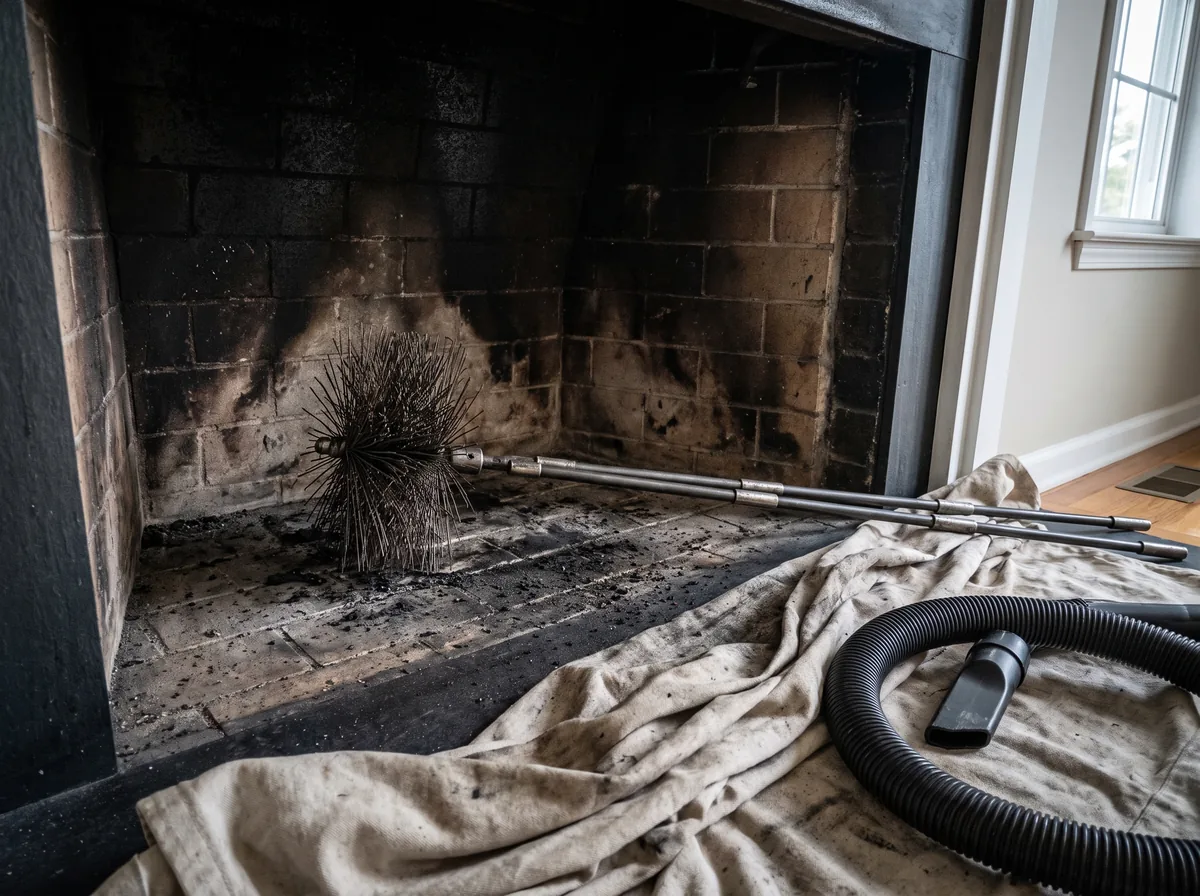
Chimney sweeping and chimney cleaning are the same job under two names. What it physically involves is the mechanical removal of combustion deposits from the inside of the flue liner, the smoke chamber and the firebox — and, done properly, an inspection of everything that becomes visible while that access is open.
The reason it matters is creosote. Creosote is the condensed residue of wood smoke: unburned volatile compounds that leave the fire as gas, cool on the way up the flue, and deposit on the liner walls. It is highly flammable. A chimney fire is accumulated creosote igniting, and it can burn at temperatures above 2,000°F — hot enough to crack liner tiles through thermal shock, damage the surrounding masonry, and in the worst case reach the structure of the house.
The thing most homeowners do not know is that creosote is not one substance. It arrives in three progressively worse forms, and the form yours is in decides whether a sweep is routine, whether it needs chemical treatment and a second visit, or whether the flue is past cleaning and the honest recommendation is to reline it. That is the substance of this page.
What NFPA 211 actually says
Two separate recommendations get conflated, and it is worth separating them.
Inspection: at least once a year, every year. NFPA 211 and the Chimney Safety Institute of America both recommend annual inspection for every chimney in use. That is not conditional on how much you burn. It applies to a fireplace used twice a winter, and it applies to a chimney serving a gas or oil boiler, where nobody is producing creosote but a blockage, a cracked liner or a failed vent connector is a carbon monoxide pathway.
Cleaning: when deposits reach one eighth of an inch. That is the threshold, and it is a measurement, not a calendar. An eighth of an inch is about the thickness of two stacked nickels — less than most people picture. For a household using a wood fireplace or stove regularly through a New England winter, reaching it inside one season is normal, which is why annual sweeping is the practical answer for most wood burners. Heavy Stage 1 accumulation is also cause to clean before that thickness.
The two combine into a straightforward rule. Have it inspected every year. Sweep it when the inspection says it needs sweeping. For most wood-burning households on the South Shore those are the same visit. For a gas appliance chimney, the inspection should still happen annually even in years when there is nothing to brush out.
The mechanics of a sweep
The tools are unglamorous and the choice of them matters more than it sounds.
Brushes. Chimney brushes come in polypropylene and wire, in rotary and push-pull configurations, and in specific diameters and shapes. Diameter has to match the flue: a brush smaller than the flue leaves deposits in the corners and along the walls, and a brush significantly oversized binds in the liner. Shape has to match too, since a square clay tile flue and a round stainless liner are not the same section. Material matters as well — wire is appropriate for clay tile, and the wrong brush dragged through a stainless flexible liner can damage it. If someone arrives with one brush for every chimney, that tells you something.
Rods. Sectional extension rods drive the brush the full height of the flue, added or removed as the brush advances. Flexible rods negotiate offsets where the flue is not a straight vertical run, which on older houses it frequently is not.
Containment. This is where a good sweep is distinguishable from a bad one, because the failure is immediately visible in your living room. Drop cloths over the hearth and floor, the fireplace opening sealed, and a shop vacuum with a HEPA filter running to hold the firebox under slight negative pressure so the fine soot goes into the machine rather than into the room. Soot is fine enough to pass straight through an ordinary vacuum and be redistributed through the house, which is why the filtration specification is not a detail.
Top-down or bottom-up. Working from the top of the chimney downward — the brush-down method — uses gravity and keeps the work outside the house, and it pairs naturally with inspecting the crown, cap and upper liner while up there. Working from the firebox upward — brush-up — is the answer when roof access is unsafe, the pitch is severe, or the weather makes the roof a bad idea, and it can be done with good containment. Both are legitimate. Which one is right depends on the chimney and the day, not on a preference.
What has to be swept, not just the flue. A full sweep includes brushing the liner, sweeping the smoke chamber — the pyramidal space above the firebox opening and below the flue — and vacuuming the firebox and the smoke shelf. The smoke chamber is the part most often skipped, and it is where deposits collect most readily, because in most pre-1980 masonry fireplaces it was built with stepped corbeled brick rather than a smooth surface. Every step is a ledge, and the turbulence that rough surface creates both impairs draft and encourages deposition. The smoke shelf behind the damper collects everything that falls back down. A sweep that brushes the flue and ignores those two has left the deposits in the places they most like to be.
The three stages of creosote
The stage determines the method, the cost, the number of visits, and in the worst case whether cleaning is the right answer at all.
Stage 1 — first-degree creosote. Loose, flaky, sooty deposits, grey to black, with the consistency of ash. This is what a chimney produces when it is burning well-seasoned wood with adequate draft and the flue is running hot enough to carry the volatiles out rather than condense them. It brushes out readily. This is the only stage routinely managed by sweeping alone, and it is what a well-run fireplace should be producing.
Stage 2 — second-degree creosote. Crunchy, tar-like deposits with a shiny surface, sometimes described as looking like cornflakes stuck together with tar. It forms when fires smoulder rather than burn, when the wood is wet or green, or when the flue is oversized for the appliance, which slows the gas and lets it cool below the temperature at which the volatiles would have stayed airborne. It is substantially harder to remove and cannot be reliably brushed out. The methods are rotary tools specifically made for it, chemical treatment with liquid or powder creosote-modifying agents, or both. Chemical treatment works by converting the deposit into a more friable form that can then be swept, which takes time — so Stage 2 often means two visits: treat, let it work, come back and clean. Anyone quoting a single one-hour visit for a confirmed Stage 2 flue has not understood what is in it.
Stage 3 — third-degree glaze. A hard, dense, black, glassy coating bonded tightly to the liner walls. It looks like the flue has been painted with tar and then fired. This is the dangerous one. Dense glaze is highly flammable and can sustain a chimney fire burning above 2,000°F, which is hot enough to crack clay tile through thermal shock and to crack brick and mortar elsewhere in the structure even when the exterior looks untouched. Removal is difficult and hazardous: poultice creosote removers applied and left to penetrate before being taken off, controlled liquid products, or mechanical rotary chains, usually over several visits. And there is a threshold beyond which removal stops making economic sense. In severe cases, relining is more cost-effective than glaze removal, particularly where the tiles have already been damaged by earlier chimney fires — which, in a flue that has accumulated that much glaze, is a real possibility. Spending $1,500 removing glaze from a liner that then has to be replaced anyway is the outcome worth avoiding, and it is the reason the inspection comes before the quote.
You generally cannot tell which stage you have from the firebox. A technician identifies it with a light and a mirror, or with a camera, during inspection. What should raise your suspicion of Stage 2 or 3: burning unseasoned wood, a habit of damping the fire down to smoulder overnight, a flue that is oversized for the appliance, and simply not having had the chimney swept for a number of years.
Seasonal burning and why it builds deposits faster
There is a local pattern worth naming, and White Horse Beach is the clearest example of it.
Seasonal beach communities on Plymouth Bay contain a lot of cottages that are used in shoulder season — cool spring and autumn weekends when the house is cold, the heating may be minimal or shut off, and the fireplace or wood stove does the work. That pattern produces creosote out of proportion to the number of nights burned, for reasons that follow directly from the mechanism. A cold masonry chimney in an unheated house has poor draft until the flue warms, so the first hour of every fire runs cool and smoky. Fires get lit in the evening and damped down rather than burned hot. Wood stored in a damp cottage or under a tarp behind it is often not properly seasoned. And the chimney sits unused and cold for weeks between fires with whatever was deposited still in it.
The result is a flue that has seen perhaps twenty fires in a year but is running Stage 2 deposits, while a year-round house that burns three nights a week through the winter with dry wood and a hot flue is still at Stage 1. It is why counting fires is a poor guide and measuring deposits is the right one, and why seasonal properties in Manomet, White Horse Beach and the older cottage stock along the coast are worth inspecting annually even though they are barely used.
What a sweep visit involves
- We set up containment before anything else. Drop cloths over the hearth and the floor around it, the fireplace opening sealed, and a HEPA-filtered vacuum running at the firebox. Getting this right is the difference between a clean job and fine soot redistributed through the house, and it is entirely within the contractor's control.
- We inspect before we brush. A light and a mirror, or a camera, into the flue to establish what is in there and which stage it has reached — because that determines the method. We also look at the firebox, the damper, the smoke chamber and the accessible flue walls. Brushing first and looking afterwards means the evidence has been swept away.
- We choose the brush and the direction to suit the chimney. Correct diameter and shape for the flue section, correct material for the liner type, and top-down or bottom-up depending on roof access, pitch and weather. A stainless flexible liner and a square clay tile flue want different treatment, and using the wrong brush in a metal liner can damage it.
- We sweep the flue, the smoke chamber and the smoke shelf. The full length of the liner, then the smoke chamber above the firebox opening, then the smoke shelf behind the damper, then the firebox vacuumed out. The smoke chamber and smoke shelf are the parts most often left, and on a corbeled pre-1980 fireplace they are where the deposits are heaviest.
- Stage 2 deposits get treated, then cleaned on a second visit. Where the deposits are crunchy and tar-like, rotary tooling and a creosote-modifying chemical treatment are what work. The treatment needs time to convert the deposit into something that can be swept, so this is generally a two-visit job and we will say so up front rather than after the first attempt fails.
- Stage 3 glaze gets an honest assessment first. Glaze removal is multiple visits with poultice or liquid products and mechanical work, and it is not always the right spend. Before starting, we establish the condition of the liner underneath, because if the tiles are cracked from previous chimney fires the money is better put into relining. You should get that comparison before you commit, not halfway through.
- We report the rest of the chimney while we are there. Crown, cap, flashing, mortar joints, liner condition, damper operation and the smoke chamber, with photographs. A sweep gets someone onto the roof and into the firebox of a chimney that is otherwise never looked at, and the inspection is a large part of the value of the visit. Where the flue needs a camera scan — after a chimney fire, on a change of appliance or fuel, at a property sale, or where something found suggests a possible hazard — that is the Level 2 scope and we will tell you it is warranted.
What this costs on the South Shore
These are realistic Eastern Massachusetts ranges, published so you can sanity-check any quote you are given — including ours. What moves the number on a routine sweep is the number of flues, chimney height, roof access, and how long it has been since the last cleaning. A two-flue chimney — common in New England houses with a heating flue and a fireplace flue in the same stack — takes roughly twice as long as a single flue. A standard sweep and Level 1 inspection on a single-flue masonry chimney runs about 45 minutes to an hour and a half; a video scan adds 30 to 60 minutes. Beyond that, the creosote stage is the variable, and it is the reason we look before quoting a method. If a flue turns out to be Stage 3, the useful question is not what removal costs but whether removal or relining is the better spend.
How to produce less creosote in the first place
Sweeping is the remedy. The deposit rate is largely under your control, and it follows directly from the mechanism: creosote forms when volatile gases cool below their condensation point inside the flue. Anything that keeps the flue hot and the combustion complete reduces it.
- Burn seasoned wood. Wet or green wood spends the fire's energy evaporating water instead of raising flue temperature, and the resulting cool, smoky burn is the classic route to Stage 2 deposits. Split, stacked, covered on top and open at the sides, for a year or more.
- Do not damp a fire down to smoulder. A smouldering fire is an incomplete burn producing a maximum of volatiles at a minimum of flue temperature. It is the single most effective way to glaze a flue.
- Warm the flue before you build the fire up. A cold exterior masonry chimney drafts poorly until it warms. Priming it — a lit rolled newspaper held up at the damper for a moment — establishes draft and avoids a cold smoky start.
- Get the flue size right. An oversized flue slows the gas and lets it cool, which is a structural cause of Stage 2 rather than a habit. This is common where a wood stove has been vented into a large fireplace flue, or where an appliance has been changed without resizing. The fix is a correctly sized liner.
- Keep the cap on and the flue clear. A missing cap lets rain into the flue, and a wet flue runs cooler and drafts worse. Nests and debris do the same thing by restricting the section.
Gas and oil appliance chimneys still need the annual visit
A gas fireplace or gas boiler produces minimal creosote, so sweeping in the traditional sense is much less critical. The annual inspection is not less critical, and there is an argument it matters more, because homeowners tend to assume a gas appliance needs no attention at all.
What is being checked on a gas or oil appliance chimney is the venting: whether the flue is clear, whether the liner is intact, whether the vent connector between appliance and chimney is sound, and whether the flue is correctly sized for what is now attached to it. A blocked or deteriorated gas appliance vent is a carbon monoxide pathway. So is a cracked liner, which lets combustion gas migrate through the masonry into wall cavities rather than up and out.
On the South Shore there is a specific and widespread version of this. The region converted heavily from oil to gas from roughly 2005 onwards as gas distribution expanded through Quincy, Braintree, Weymouth and Hingham, and a great many of those conversions were done without resizing the flue. A clay tile liner sized for a 200,000 BTU oil boiler now venting a 100,000 BTU gas boiler is roughly twice the cross-section needed. The gas moves too slowly, cools below its dew point, and condenses; the condensate is acidic and attacks the tile and mortar joints from inside. A liner that was serviceable on oil can fail within a few years of conversion. If your appliance has changed, that is one of the situations where the camera scan of a Level 2 inspection is warranted rather than optional.
If you think you have had a chimney fire
A chimney fire announces itself with a loud crackling or roaring from the chimney, dense billowing smoke, flames visible at the chimney top, and intense heat at the chimney breast or the exterior wall near the stack. Not all of them do. A low-oxygen fire smouldering in heavy glaze can burn without the characteristic roar and do the same damage.
If one is happening: get everyone out of the house and call 911. If it is safe and takes under ten seconds, close the fireplace doors and the damper on the way past. Do not climb onto the roof. Do not put water on a masonry chimney fire. Stay outside and let the fire department deal with it.
Afterwards, do not use the fireplace or any appliance connected to that chimney until it has been inspected. A fire that reached 2,000°F can crack liner tiles, warp metal damper components, damage the smoke chamber and crack brick and mortar through the structure while leaving the outside looking unchanged. NFPA 211 calls for a Level 2 inspection, including a full video scan of the flue, after any chimney fire — and if you merely suspect one happened, that is reason enough to have the scan done.
What people ask about this job
How often should I have my chimney swept?
The CSIA and NFPA 211 both recommend annual inspection for every chimney in use. For wood-burning fireplaces and stoves, sweeping should happen whenever deposits reach one eighth of an inch — which for regular winter use in New England generally means annually. For a gas appliance chimney serving a furnace, boiler or water heater, annual inspection is the minimum; sweeping may not be needed every year if the appliance is venting cleanly, but the inspection should still happen.
What is the difference between a sweep and an inspection?
A sweep is the mechanical removal of creosote, soot and debris from the flue, smoke chamber and firebox. An inspection is a structured assessment of the chimney's condition against NFPA 211 — structural integrity, liner condition, crown, cap, flashing and clearances. They are usually done together on the same visit. A Level 1 inspection is the standard annual check; a Level 2 adds a video camera scan of the full flue interior, and is what NFPA 211 calls for on a change of ownership, a change of appliance or fuel, after a chimney fire, or when a Level 1 turns up evidence of a possible hazard.
What is creosote and why is it dangerous?
Creosote is the residue deposited inside the flue when wood burns — volatile compounds that leave the fire as gas and condense on the cooler liner walls. It ranges from fluffy soot that brushes out, through crunchy tar-like deposits, to a hard glassy glaze. It is highly flammable, and a chimney fire is accumulated creosote igniting. Chimney fires can exceed 2,000°F, crack liner tiles, damage the surrounding masonry and potentially reach the structure of the house. Regular sweeping is what prevents the accumulation getting that far.
How do I know if I have Stage 3 glaze?
You generally cannot tell from the firebox, which is why identification happens during an inspection with a light and mirror or a video camera. Stage 1 is fluffy grey or black soot and brushes out. Stage 2 is crunchy, shiny and tar-like and is obvious to a trained eye. Stage 3 is hard, glossy black glaze bonded to the liner. The circumstances that make glaze a real possibility are burning green or unseasoned wood, a habit of damping fires down to smoulder, an oversized flue, and not having had the chimney swept for many years.
How long does a sweep take?
A standard sweep with a Level 1 inspection typically takes 45 minutes to an hour and a half on a single-flue masonry fireplace chimney. A Level 2 inspection with a video scan adds 30 to 60 minutes. A two-flue chimney — common in New England houses with a furnace flue and a fireplace flue in the same stack — takes roughly twice as long. Stage 2 or Stage 3 deposits change the picture entirely, because those need chemical treatment with time to work and therefore more than one visit.
Will sweeping make a mess in the house?
It should not. Proper containment is drop cloths over the hearth and floor, the fireplace opening sealed, and a HEPA-filtered vacuum holding the firebox under slight negative pressure so fine soot goes into the machine rather than into the room. Soot is fine enough to pass straight through an ordinary shop vacuum and get redistributed through the house, so the filtration specification genuinely matters. This is entirely within the contractor's control, and a sooty room afterwards is a process failure, not an unavoidable feature of the job.
Often needed alongside this
Chimney Inspection
Level 1, 2 and 3 inspections, including the camera scan buyers and insurers ask for.
Read more →Liner Installation & Relining
Cracked clay tile, or an oil-era flue now venting a gas boiler — the most common serious defect we find on the South Shore.
Read more →Caps & Dampers
Keep rain, snow and animals out of the flue, and stop heated air escaping up it all winter.
Read more →Book the sweep before the burning season
Tell us what you are seeing and we will tell you what it is likely to be, what it will take to fix, and roughly what it should cost — before anyone climbs on your roof.
Prefer to talk it through? The phone is answered around the clock, by a person, including during storms.
We work across Quincy, Braintree, Weymouth, Hingham, Milton, Hull, Cohasset, Scituate, Norwell, Marshfield and the rest of the South Shore.