Levels 1, 2 & 3
Chimney inspection across the South Shore
There are three defined levels of chimney inspection, they are not interchangeable, and which one you need is decided by your circumstances — not by whoever is quoting you.
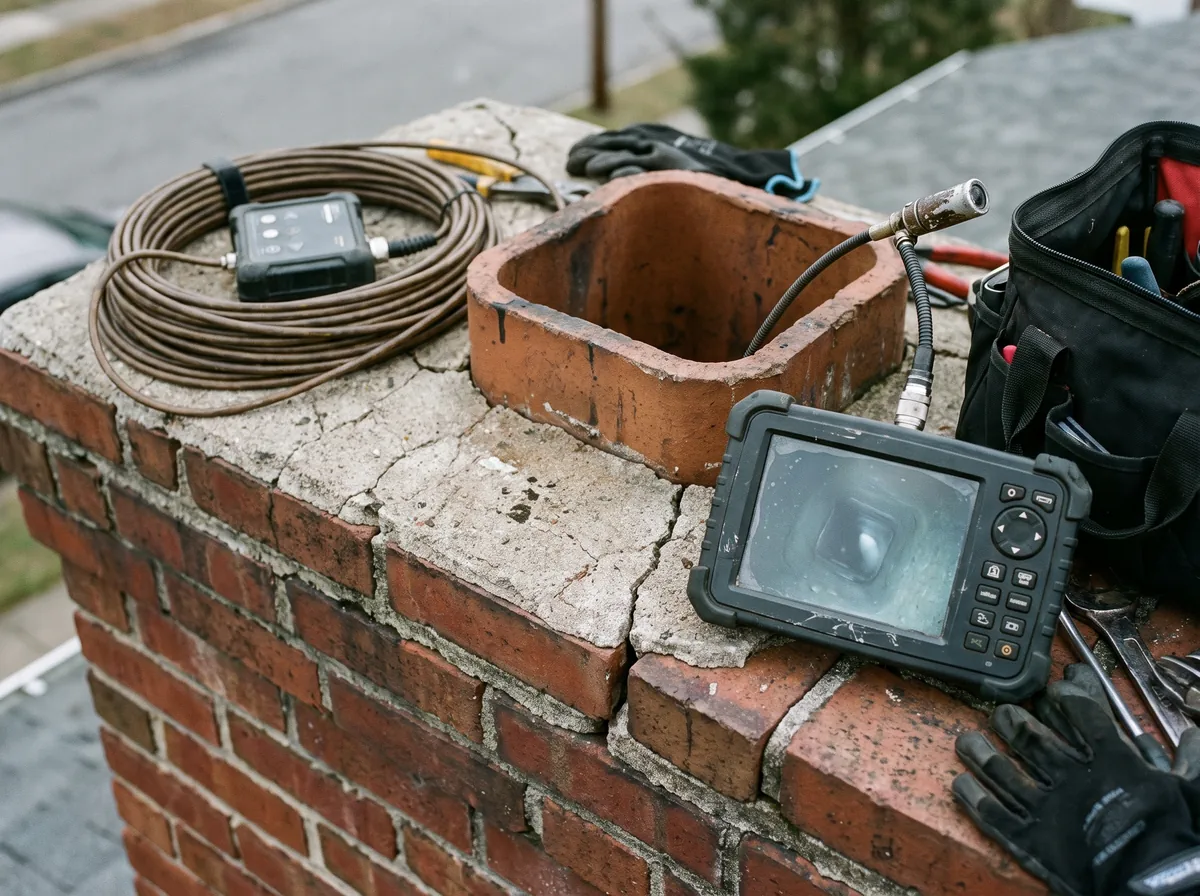
An inspection is the only chimney service you buy purely for information. Nothing is repaired, nothing is cleaned, and at the end of it you own a set of findings rather than a new component. That makes it the easiest service to sell badly, and it is why so many South Shore homeowners end up paying for the wrong one — a cursory look when they needed a camera down the flue, or an expensive scan when a routine annual check was all that was called for.
The levels are not marketing tiers invented by contractors. They are defined in NFPA 211, the national standard for chimneys, fireplaces, vents and solid fuel burning appliances, and taught by the Chimney Safety Institute of America. Level 1, Level 2 and Level 3 each describe a specific physical scope of work, and the standard also sets out the circumstances that require you to move up from one to the next. A competent inspector does not choose the level based on what you are willing to spend. They choose it based on what has happened to your chimney and what is about to happen to your house.
What follows is what each level physically covers, what triggers it, and what it costs on the South Shore. Almost no competitor sets this out plainly, which is why the phrase 'chimney inspection' gets used to mean anything from a thirty second glance at the firebox to a two hour documented survey.
Level 1: the minimum annual inspection
A Level 1 inspection covers the readily accessible portions of the chimney, inside and out. 'Readily accessible' is doing real work in that sentence: it means what can be reached and seen without moving furniture, dismantling appliances, or opening up any part of the building.
In practice that means the inspector examines the firebox and its refractory brick and joints, the damper and its operation, the accessible interior of the flue, the exterior masonry of the whole stack for spalling and open mortar joints, and the cap and crown from the roof. The tools are a light, a mirror, a probe and a ladder. It takes 30 to 60 minutes on a single-flue chimney and longer on a two-flue stack, which is common in New England homes where a heating appliance and a fireplace share a chimney.
A Level 1 is the right inspection when the chimney is in continued service, nothing has changed about the appliance or the fuel it burns, and you have no reason to suspect a problem. The CSIA and NFPA 211 both recommend that every chimney in use is inspected at least once a year, which is what this level is for. It is routinely bundled with a sweep, and that is a sensible pairing, because heavy creosote deposits obscure the liner surface the inspector is trying to look at.
What a Level 1 will not do is show you the inside of the flue above the smoke chamber. Thirty feet of clay tile running up the middle of your chimney is not readily accessible by any definition. That is the boundary between Level 1 and Level 2, and it is the single most important thing to understand before you book.
Level 2: everything in Level 1, plus a camera down the flue
A Level 2 inspection includes the entire scope of a Level 1 and adds two things. The first is a video camera scan of the full interior of the flue, top to bottom. The second is examination of accessible areas of the building through which the chimney passes — attics, crawlspaces and basements — so the chimney structure can be assessed from inside the house as well as outside it, and so that clearances to combustible framing can be looked at.
This is the inspection buyers, sellers, realtors and insurers mean when they ask for a 'camera scan'. It typically takes 60 to 120 minutes. NFPA 211 calls for a Level 2 in four situations, and they are worth knowing precisely:
- On a change of fuel type or appliance. Swapping an oil boiler for a gas one, putting a wood stove insert into an open fireplace, or replacing an appliance with one of a different input rating all change what the flue is being asked to do.
- On transfer of the property. A sale, in other words. The chimney is the one major system in a house that a general home inspection cannot see the inside of.
- After a chimney fire. A chimney fire can exceed 2,000°F and crack liner tiles by thermal shock while leaving the outside of the chimney looking untouched. Nothing connected to that chimney should be used again until a Level 2 has been completed.
- When a Level 1 turns up evidence of a possible problem. If the annual check finds debris in the firebox, a cracked crown, staining, or an unexplained draft complaint, the inspector escalates. A Level 1 that finds something and stops there has answered nothing.
Note what is not on that list: wanting a camera scan because you feel like it. That is a perfectly reasonable reason to buy one, and on a chimney of unknown history it is usually money well spent. But it is not a requirement, and you should not be told it is.
What a camera scan actually reveals
The scan is the point of a Level 2, so it is worth being specific about what shows up on the screen and why each finding matters.
- Cracked flue tiles. Clay tile cracks from freeze–thaw movement and from the thermal shock of a chimney fire. A cracked liner is a safety matter rather than a maintenance one, because it can let combustion gases — including carbon monoxide — pass out of the flue into the chimney structure and from there into wall cavities.
- Failed mortar joints between tiles. The joints erode before the tiles do, particularly where water has been running down the flue from a failed crown, and particularly on gas-converted flues where acidic condensate attacks the mortar. Open joints are the same hazard as a cracked tile.
- Blockages. Bird and animal nests, fallen tile fragments, leaves and building debris. A blocked flue back-pressures combustion products into the room, which is one of the recognised carbon monoxide pathways.
- Stage 3 glaze. Hard, glossy, black creosote bonded to the liner wall. It is highly flammable, it is difficult and expensive to remove, and you will not know it is there without looking. On a chimney where green wood has been burned or fires have been left to smoulder, it is a real possibility.
- Offsets, voids and missing liner. Older chimneys sometimes have no liner at all above a certain point, or have sections where tiles have collapsed entirely. A pre-1910 chimney may never have had one.
- Cross-venting in multi-flue stacks. On Quincy and North Plymouth two-families and triple-deckers, several flues often run inside one chase. Where the masonry between them has broken down, combustion gases from one appliance can migrate into another flue and, potentially, into a neighbouring unit.
None of that is visible from the firebox with a flashlight, and none of it is visible from the roof. It is visible on camera, which is the entire argument for the Level 2.
Level 3: invasive, and genuinely rare
A Level 3 inspection is indicated only when a Level 2 has found — or strongly suggests — a serious hazard that cannot be assessed any other way. It is invasive by definition. It may involve removing chimney components, sections of the chimney structure, or parts of the building fabric such as an interior wall, in order to reach concealed portions of the chimney and the framing around it.
It is ordered when structural compromise is suspected, and it is most often triggered after a significant chimney fire or an impact event. Because the scope depends entirely on how much has to be opened up, there is no standard price for it, and any contractor quoting a flat Level 3 fee before a Level 2 has been done is quoting for work nobody has yet scoped.
Two things follow from that. First, nobody should be selling you a Level 3 at the point of first contact. Second, if a Level 2 finds something that warrants one, that finding is serious and the chimney should be taken out of service until it is resolved.
What actually happens during the inspection
- We establish why you want it before we quote a level. The trigger determines the level, so the first questions are about history rather than the chimney itself: what appliance is connected, whether it has changed, whether the house is under agreement, whether there has ever been a chimney fire, and what you have noticed. A buyer with a closing date and an owner booking an annual check need two different inspections at two different prices.
- Firebox, damper and smoke chamber. We look at the firebrick and the refractory joints for cracks that could let flame reach the surrounding masonry, operate the damper and check whether it closes and seals, and examine the smoke chamber above the firebox opening for open joints and corbelled brickwork. Damper condition is one of the most common findings on older South Shore fireplaces and feeds straight into the cap and damper conversation.
- The exterior and the top. From the roof we assess the crown for cracking and delamination, the cap or its absence, the condition of the top courses of brick, the flashing at the roofline, and the mortar joints down the stack. Crown and liner problems travel together, so what we find up here shapes what we expect to see on camera.
- The camera scan, on a Level 2. A camera on a rod or cable is run the full height of the flue and the footage is recorded. We are looking for cracked tiles, open joints, blockages, deposits and any point where the liner is missing. If the flue is heavily sooted, deposits hide the liner surface, so a sweep is done first — otherwise the scan records the creosote rather than the chimney.
- Accessible runs inside the house. On a Level 2 we follow the chimney through the building where we can reach it: the basement, the attic, and any crawlspace it passes through. We are checking for staining, cracked masonry, missing parging, and clearance between the chimney and combustible framing.
- The report, with photographs. You get written findings with photographs and, on a Level 2, stills or footage from the scan. This matters beyond the inspection itself: a dated, documented report is what you negotiate a purchase price with, what you hand an insurer, and what you compare against a repair quote from anyone else.
- What we recommend, and what we do not. Findings are separated into what is a safety matter, what is deterioration that should be addressed on a timeline, and what is cosmetic. If the chimney is unsafe to use we say so plainly and explain why. If it is fine, that is the finding, and it is a perfectly normal outcome.
What this costs on the South Shore
These are realistic Eastern Massachusetts ranges, published so you can check any quote you are given against them — including ours. What moves the number is the number of flues, the height and access of the chimney, and whether the flue needs sweeping before it can be scanned. A two-flue chimney takes roughly twice as long as a single-flue one, which is why a triple-decker in West Quincy does not price like a ranch in Abington. A Level 1 runs 30 to 60 minutes; a Level 2 runs 60 to 120.
Buying or selling a house on the South Shore
Property transfer is one of the four circumstances NFPA 211 identifies as requiring a Level 2, and it is the one with a deadline attached. If you are under agreement, you are working inside an inspection contingency period measured in days, and the chimney is the one major system in the house whose interior nobody has looked at.
If you are buying. A general home inspection is a different scope of work. It is broad by design and it does not include running a camera thirty feet up a flue. If no camera went down the chimney, you did not get a Level 2, whatever the report is titled. What a Level 2 changes is your negotiating position: it converts 'the chimney looks old' into a documented list with costs attached. Tuckpointing, crown repair, a cap and a sweep are routine negotiable items. A cracked or absent liner, a collapsed flue, or a chimney needing full rebuild are a different order of number — relining runs $1,500 to $4,000 for most gas installations and an above-roofline rebuild runs $3,000 to $8,000 — and those are the findings that change what a house is worth to you.
If you are selling. Inspecting before you list rather than after you are under agreement is the difference between pricing a known repair into the asking price and having it discovered by the buyer's inspector at the worst possible moment. A clean, dated Level 2 report is also a straightforward answer to a buyer who has been told by somebody that old chimneys are a liability.
If the house is old. Plymouth has the highest concentration of pre-1800 structures on the South Shore, and Hingham, Cohasset and Milton carry large stocks of pre-1900 housing. Many of those chimneys were built for open hearths rather than furnaces and predate tile lining entirely. Whether a chimney of that age is safe to use with a modern appliance is a real question, and it is not one anybody can answer from the ground.
Oil to gas: the conversion that requires a Level 2
Changing the appliance or the fuel is a Level 2 trigger in its own right, and on the South Shore it is the most common one after a house sale. Natural gas distribution expanded through Quincy, Braintree, Weymouth, Hingham and into parts of Plymouth from roughly 2005, and a large number of homes swapped an oil boiler for a gas one and kept the chimney exactly as it was.
The mechanism is straightforward. An oil appliance vents hot, relatively dry flue gas at a high BTU input — commonly 150,000 to 250,000 — and the clay tile flue was sized for that. A replacement gas appliance may run at 50,000 to 150,000 BTU and vents cooler, wetter gas, often below the dew point inside the flue. In a flue roughly twice the cross-section it now needs, the gas slows, cools further and condenses. That condensate is acidic, and it attacks clay tile and mortar joints far faster than anything the chimney experienced under oil. A liner that had decades left in it under oil can deteriorate within a handful of years after conversion.
Massachusetts code requires the liner to be adequate for the appliance served and requires resizing when the appliance changes; sizing follows BTU input and vent height, not the dimensions of whatever tile is already in there. A Level 2 scan is how you find out what ten or fifteen years of condensate has done. The remedy, where one is needed, is a correctly sized listed stainless liner — see liner installation for how that work is done and what it costs, including the building permit and inspection that Massachusetts requires for liner work.
CSIA certification, HIC registration, and how to check who you are hiring
Two credentials matter in this trade and they do completely different things. Neither is claimed here on behalf of anyone; this is how to interrogate any quote you receive, this one included.
CSIA certification is the technical one. The Chimney Safety Institute of America issues the Certified Chimney Sweep credential, which requires passing a written examination on chimney inspection, cleaning and safety standards and maintaining continuing education to keep it current. It is the one credential in the industry that demonstrates competence against a nationally recognised standard, and it is the one to ask about by name. Ask for the individual technician's status rather than the company's — certification attaches to people.
Be careful with adjacent names. The National Chimney Sweep Guild is the trade association for the industry; membership signals professional engagement but it is not a competency examination and should not be presented as equivalent to CSIA certification. The National Fireplace Institute certifies gas appliance installation and service, which is the relevant credential for gas insert and gas log work rather than for masonry or sweeping.
Massachusetts HIC registration is the legal baseline. Any contractor performing home improvement work in Massachusetts is required to hold Home Improvement Contractor registration, and you can verify a registration yourself at mass.gov. It is consumer protection rather than a competency test — it says nothing about whether someone can read a flue scan — but it is a legal requirement, and a contractor operating without it has no statutory right to recover payment and is exposed to fines. Checking takes a couple of minutes and is worth doing before anyone is on your roof.
What people ask about this job
Which level of inspection do I actually need?
If nothing has changed — same appliance, same fuel, no fire, no symptoms — a Level 1 annually is the correct answer and anything more is optional. Move to a Level 2 if the property is changing hands, the appliance or fuel type has changed, there has been a chimney fire, or a Level 1 found something that needs explaining. Level 3 is not something you choose; it follows from a Level 2 finding a hazard that cannot be assessed without opening the structure up.
I am buying a house. Isn't the chimney covered by the home inspection?
Only partly. A general home inspection is broad by design and typically covers what is visible — the exterior stack, the firebox, the damper. It does not include a video scan of the flue interior, which is the part of a Level 2 that finds cracked tiles, failed joints and blockages. If no camera went down the flue, you have not had a Level 2 regardless of what the report is called. Given that a liner replacement runs $1,500 to $4,000 and a rebuild considerably more, the cost of the scan is small against what it can find before you close.
How much does it cost and how long does it take?
A Level 1 runs roughly $100 to $200 and is often included in the price of a sweep, which itself runs $175 to $350 in Eastern Massachusetts. A Level 2 with a full video scan runs roughly $250 to $500. A Level 1 takes 30 to 60 minutes; a Level 2 takes 60 to 120. Multiple flues in one stack roughly multiply the time, and a chimney that needs sweeping before it can be scanned adds to both the time and the price.
My heating is gas and I never use the fireplace. Do I still need this?
Yes, and arguably more so. A gas appliance produces little creosote, so it rarely needs sweeping in the traditional sense, but the flue still needs annual inspection. Gas venting failures are the quieter hazard precisely because homeowners assume gas equipment is maintenance-free: a blocked or deteriorated gas appliance vent is a direct carbon monoxide pathway. If the gas appliance replaced an oil one and the flue was never resized, the condensation problem described above is likely to be underway.
We think we had a chimney fire. What now?
Stop using the fireplace and anything else connected to that chimney, and book a Level 2 before it is used again — that is what NFPA 211 calls for after any chimney fire. A fire burning in heavy glaze can exceed 2,000°F and crack liner tiles through thermal shock, warp damper components and damage the smoke chamber while leaving the outside of the chimney looking entirely normal. Some chimney fires are slow, low-oxygen burns in glaze that never produce the characteristic roar, so suspicion is enough of a reason to have it scanned. A documented post-fire assessment is also what an insurer will want.
Does an inspection include a sweep?
They are frequently sold together and that is usually sensible, but they are separate work. A sweep is mechanical removal of creosote, soot and debris; an inspection is an assessment against a standard. The practical connection is that heavy deposits obscure the liner, so a flue that has not been cleaned in years often has to be swept before a camera scan shows anything useful. If you are quoted a Level 2 on a heavily sooted flue with no sweep in the price, ask how the liner is going to be seen.
Often needed alongside this
Chimney Sweeping
Creosote removal and a clean flue — plus an honest answer about what stage of buildup you actually have.
Read more →Liner Installation & Relining
Cracked clay tile, or an oil-era flue now venting a gas boiler — the most common serious defect we find on the South Shore.
Read more →Caps & Dampers
Keep rain, snow and animals out of the flue, and stop heated air escaping up it all winter.
Read more →Book the right level of inspection
Tell us what you are seeing and we will tell you what it is likely to be, what it will take to fix, and roughly what it should cost — before anyone climbs on your roof.
Prefer to talk it through? The phone is answered around the clock, by a person, including during storms.
We work across Quincy, Braintree, Weymouth, Hingham, Milton, Hull, Cohasset, Scituate, Norwell, Marshfield and the rest of the South Shore.