Storm damage guide
Why Some Storms Leak and Others Don't: Wind-Driven Rain and Your Chimney
Two storms can drop the same amount of rain and only one of them stains your ceiling. The difference is not how much rain fell. It is which direction the wind drove it, and how hard.
Vertical rain is easy for a chimney to handle. It runs off the crown, off the cap, and down the roof. Wind-driven rain is a different problem entirely. It arrives sideways, at speed, and it pushes water into joints, under flashing, and through cracks that vertical rain never touches. That is why a chimney can survive a summer of downpours and leak in the first November storm.
Wind turns rain sideways
A nor'easter does not just drop rain, it drives it. Sustained wind pushes rain against the windward face of the chimney for hours, and that face takes the full force of the storm while the other three faces stay nearly dry. Water under pressure finds its way into hairline cracks, open mortar joints, and the gap where flashing meets brick, none of which leak at all in a calm rain. The first thing a leak tells you is that wind was involved, and the second thing it tells you is which side of the chimney took the hit.
Direction is the diagnosis
Every storm has a direction, and every leak has a side. When a stain appears after a storm, note which way the wind was blowing. A leak on the northeast side of the chimney after a nor'easter points to the northeast face, and that narrows the search to one face of flashing, one stretch of mortar, and one edge of the crown. Homeowners who can tell us the storm direction save a lot of time, because the weak spot is almost always on the windward side. If the leak shows up after storms from every direction, that is useful too: it means the masonry itself is saturated, not just one joint. More on how leaks get traced.
The uphill edge of the flashing
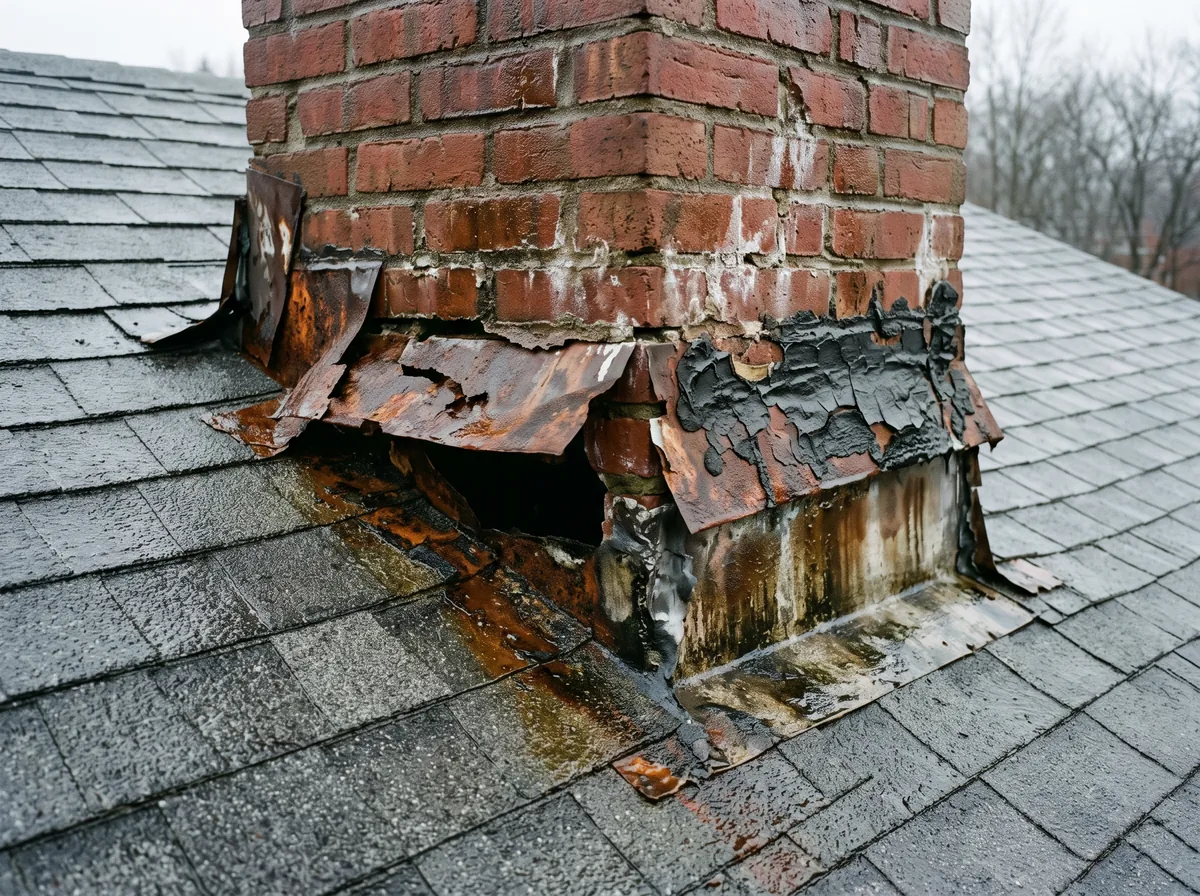
Flashing is the metal where the chimney meets the roof, and its most vulnerable spot is the uphill edge, the side facing up the roof slope. In vertical rain, water runs down the roof and over the flashing. In wind-driven rain, the wind pushes water uphill, under the top edge of the flashing, and straight down the side of the flue. Flashing that has lifted even slightly, or sealant that has dried and cracked, gives that water an open door. From the ground, look for a bent edge or a dark gap on the uphill side after a storm. Flashing work is part of leak and flashing repair.
Mortar joints soak it up
Brick and mortar absorb water, and wind-driven rain gives them hours of soaking on one face. A saturated chimney does not leak right away. The water travels slowly through the masonry and shows up inside a day or two later, sometimes well after the storm has passed, which is why the stain seems to appear out of nowhere. Open or crumbling joints absorb far more water than sound ones, so a chimney with tired mortar leaks in storms that a sound chimney shrugs off. When the mortar is the problem, repointing is the repair, and once the joints are sound, waterproofing keeps the next storm out of the masonry itself.
The crown's windward edge
The crown is the slab across the top of the chimney, and its windward edge takes the worst of every storm. A hairline crack on that edge lets driven rain straight into the brick, and the water then works down through the stack, sometimes for months, before it stains anything inside. Crowns that were built flat hold standing water, which makes the wind's job even easier. If the leak appears after wind-driven storms and the flashing looks sound, the crown is the next place to look. See crown repair for what a failing crown looks like from the ground.
What to do tonight
After the next storm, write down two things: which way the wind blew, and exactly where the stain showed up. That pair of facts is the best diagnostic clue a chimney can give you, and it is worth more than a photograph of the stain alone. Call (857) 403-9528 with the wind direction and the stain location, and we will know which face of the chimney to look at first.
Not sure what you're looking at?
Describe what you see — or can't safely reach — and we'll tell you what it likely is before anyone climbs on your roof.
Keep reading

Trace the leak to the right storm
Tell us what you are seeing and we will tell you what it is likely to be, what it will take to fix, and roughly what it should cost — before anyone climbs on your roof.
Prefer to talk it through? The phone is answered around the clock, by a person, including during storms.
We work across Quincy, Braintree, Weymouth, Hingham, Milton, Hull, Cohasset, Scituate, Norwell, Marshfield and the rest of the South Shore.
This site is protected by reCAPTCHA and the Google Privacy Policy and Terms of Service apply.